 Free
Math
Count to 5
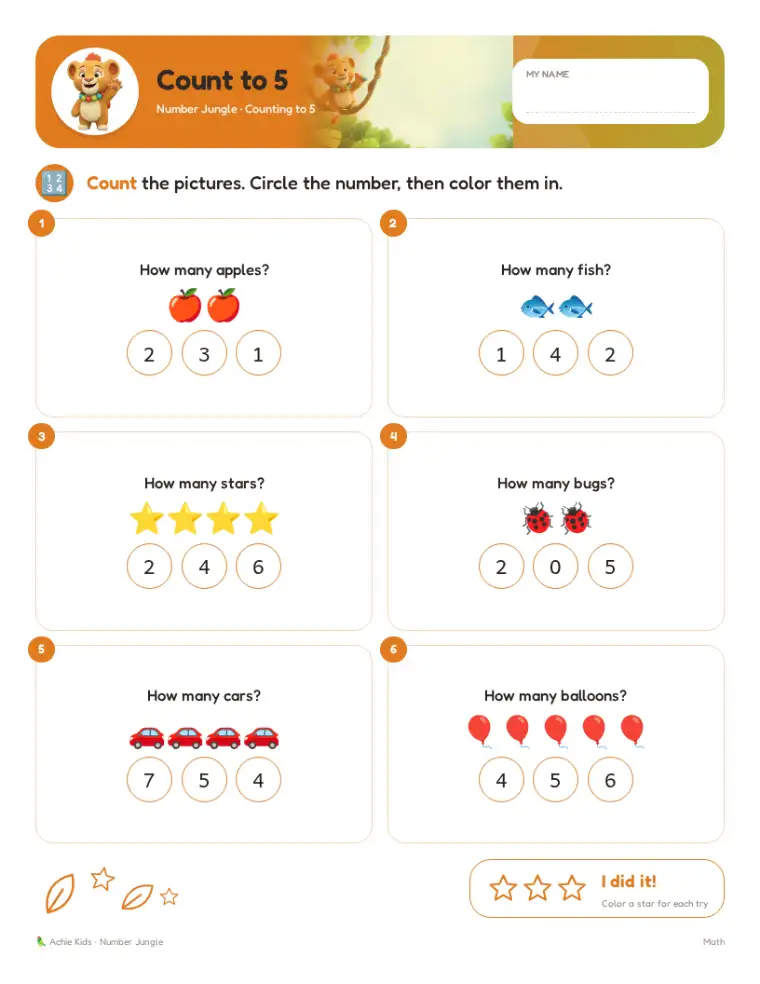
Six counting puzzles with up to 5 things to count — apples, fish and stars — grouped in fives. Touch and count each one, then circle the right number.
Ages 3–5 · 2 pages · color + ink-saver
The Worksheet Bank
FreeMath
Six counting puzzles with up to 5 things to count — apples, fish and stars — grouped in fives. Touch and count each one, then circle the right number.
Ages 3–5 · 2 pages · color + ink-saver
Math
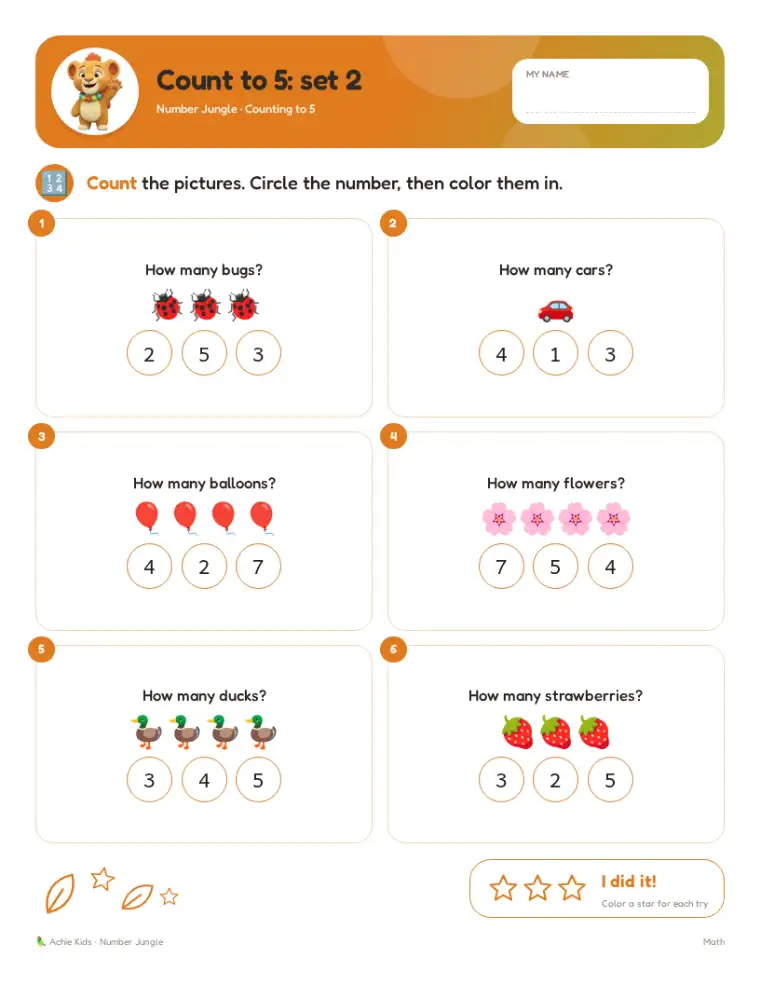
Six counting puzzles with up to 5 things to count — bugs, cars and balloons — grouped in fives. Touch and count each one, then circle the right number.
Ages 3–5 · 2 pages · color + ink-saver
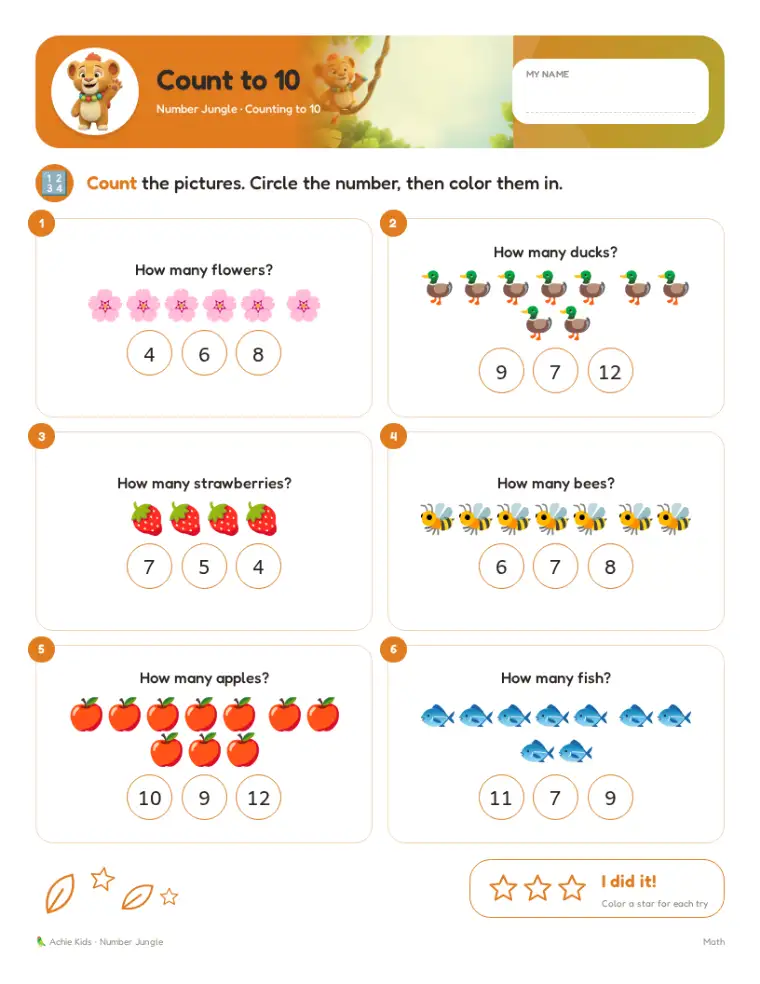
Math
Six counting puzzles with 3 to 10 things to count — flowers, ducks and strawberries — grouped in fives. Touch and count each one, then circle the right number.
Ages 4–5 · 2 pages · color + ink-saver
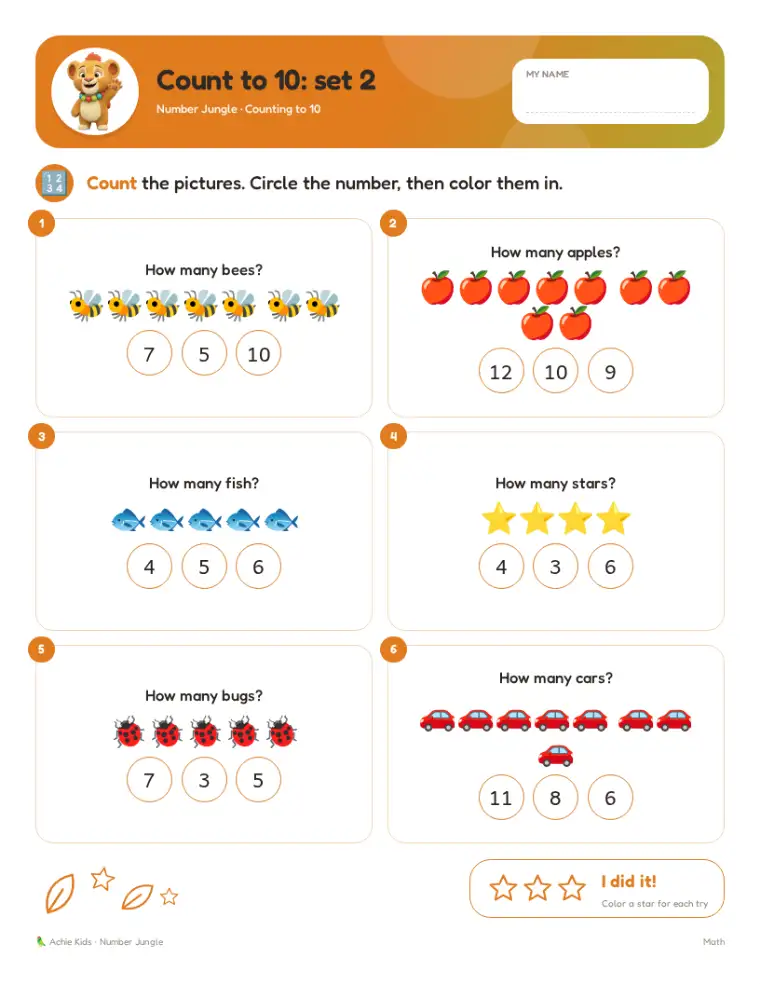
Math
Six counting puzzles with 4 to 10 things to count — bees, apples and fish — grouped in fives. Touch and count each one, then circle the right number.
Ages 4–5 · 2 pages · color + ink-saver
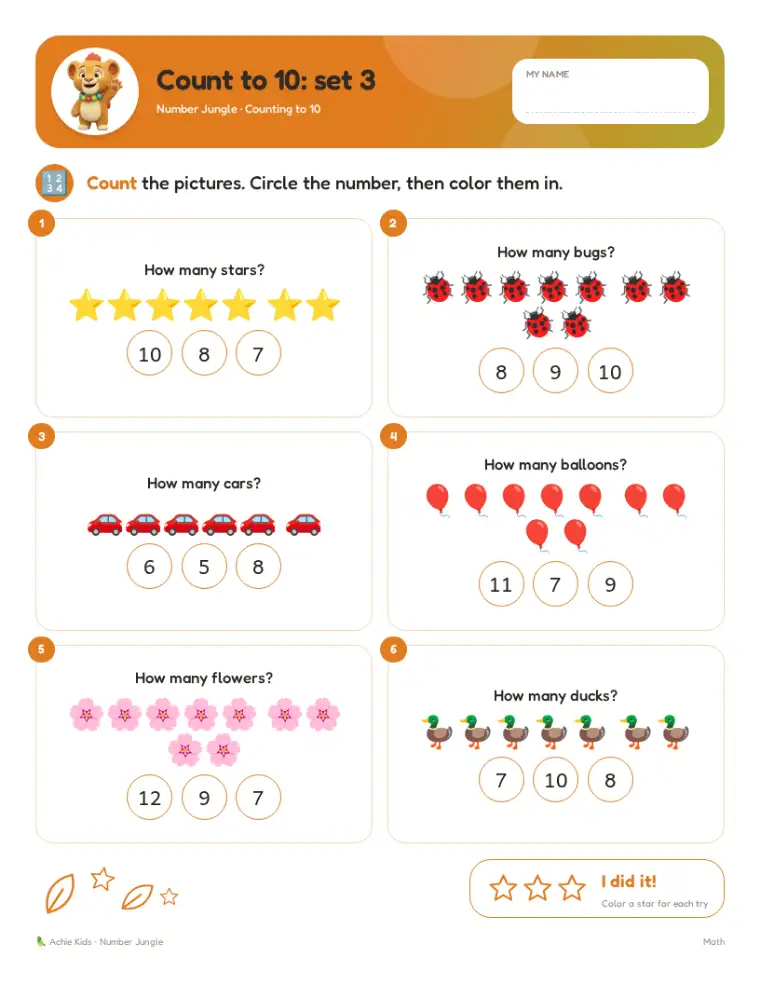
Math
Six counting puzzles with 5 to 10 things to count — stars, bugs and cars — grouped in fives. Touch and count each one, then circle the right number.
Ages 4–5 · 2 pages · color + ink-saver
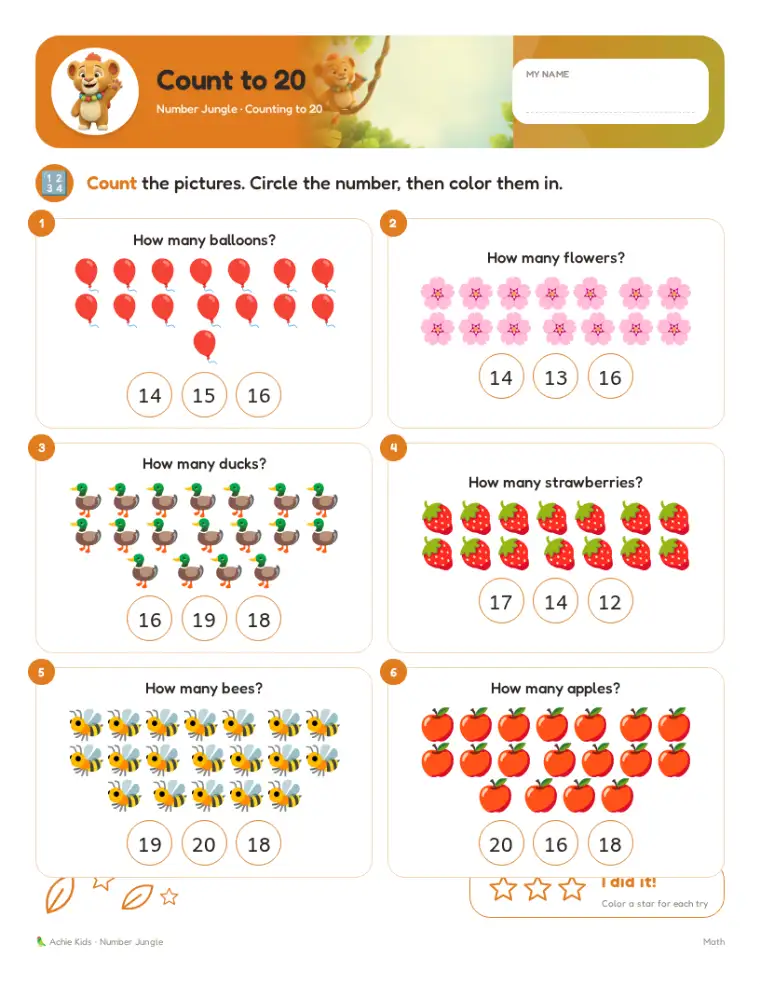
Math
Six counting puzzles with 10 to 20 things to count — balloons, flowers and ducks — grouped in fives. Touch and count each one, then circle the right number.
Ages 5–6 · 2 pages · color + ink-saver
Math
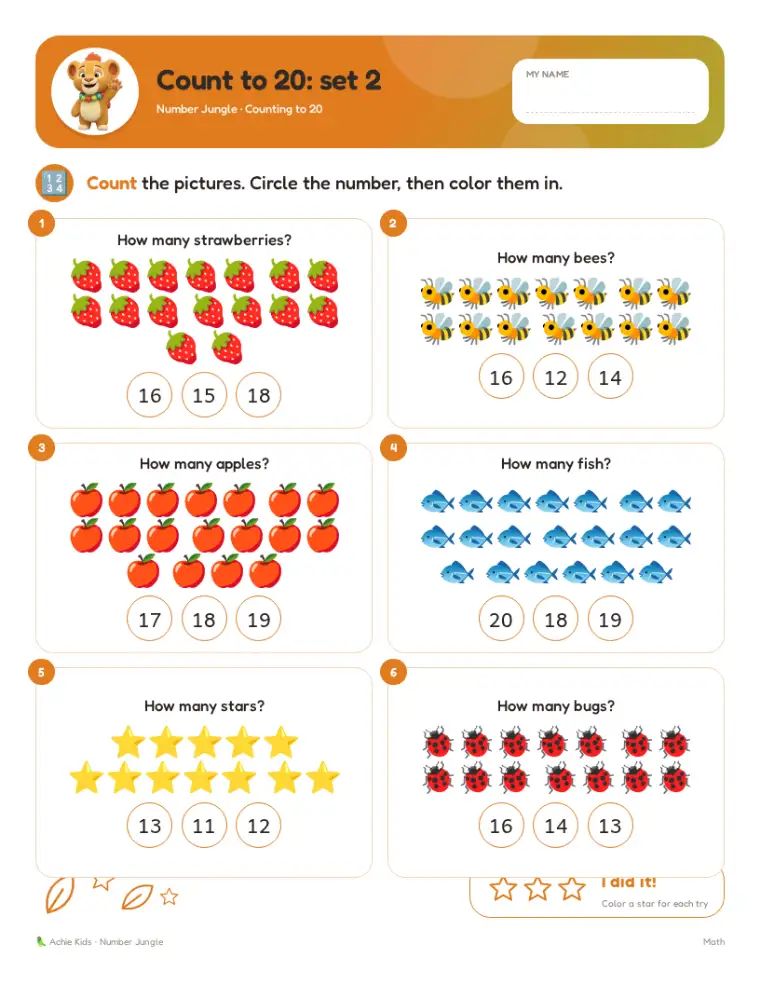
Six counting puzzles with 11 to 20 things to count — strawberries, bees and apples — grouped in fives. Touch and count each one, then circle the right number.
Ages 5–6 · 2 pages · color + ink-saver
Math
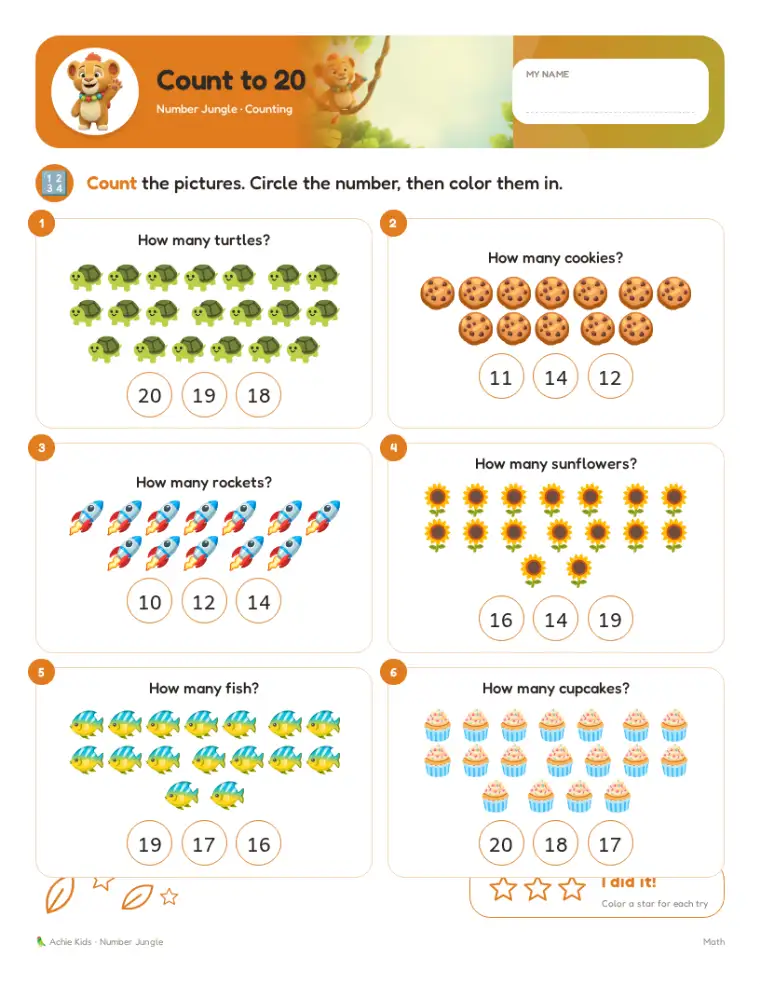
Six more counting puzzles between 12 and 20 — turtles, cookies, rockets and sunflowers in groups of five. Count the full fives first (5, 10, 15) and then count on.
Ages 5–6 · 2 pages · color + ink-saver
 Free
Math
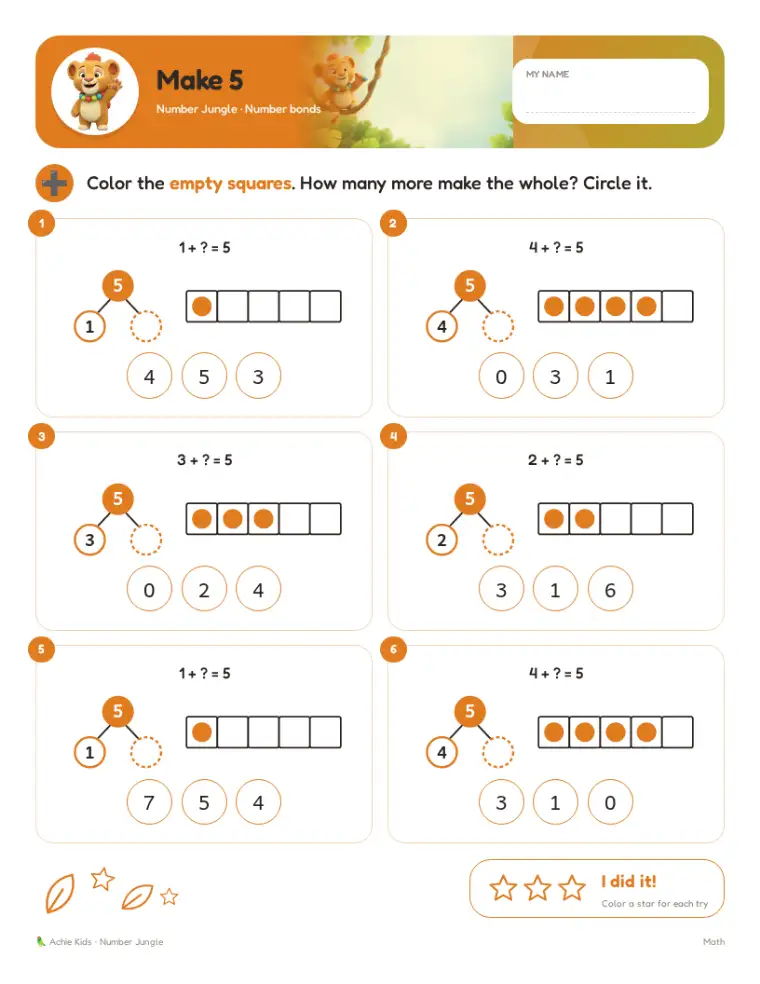
Six part–whole puzzles for 5: 1 + … = 5, 4 + … = 5 and 3 + … = 5. Each has a ten frame to color, so your child can see the missing part.
Ages 4–5 · 2 pages · color + ink-saver
Math
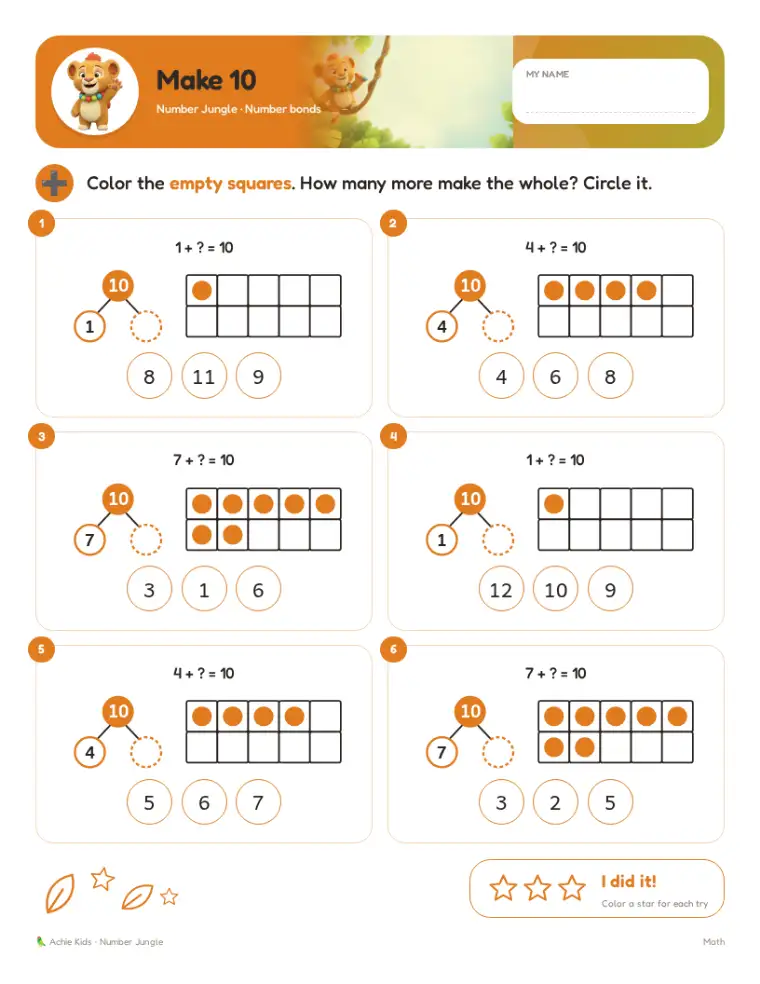
Six part–whole puzzles for 10: 1 + … = 10, 4 + … = 10 and 7 + … = 10. Each has a ten frame to color, so your child can see the missing part.
Ages 4–5 · 2 pages · color + ink-saver

Math
Six part–whole puzzles for 10: 4 + … = 10, 7 + … = 10 and 1 + … = 10. Each has a ten frame to color, so your child can see the missing part.
Ages 5–6 · 2 pages · color + ink-saver

Math
Six part–whole puzzles for 6 to 9: 1 + … = 6, 3 + … = 7 and 5 + … = 8. Each has a ten frame to color, so your child can see the missing part.
Ages 5–6 · 2 pages · color + ink-saver
 Free
Math
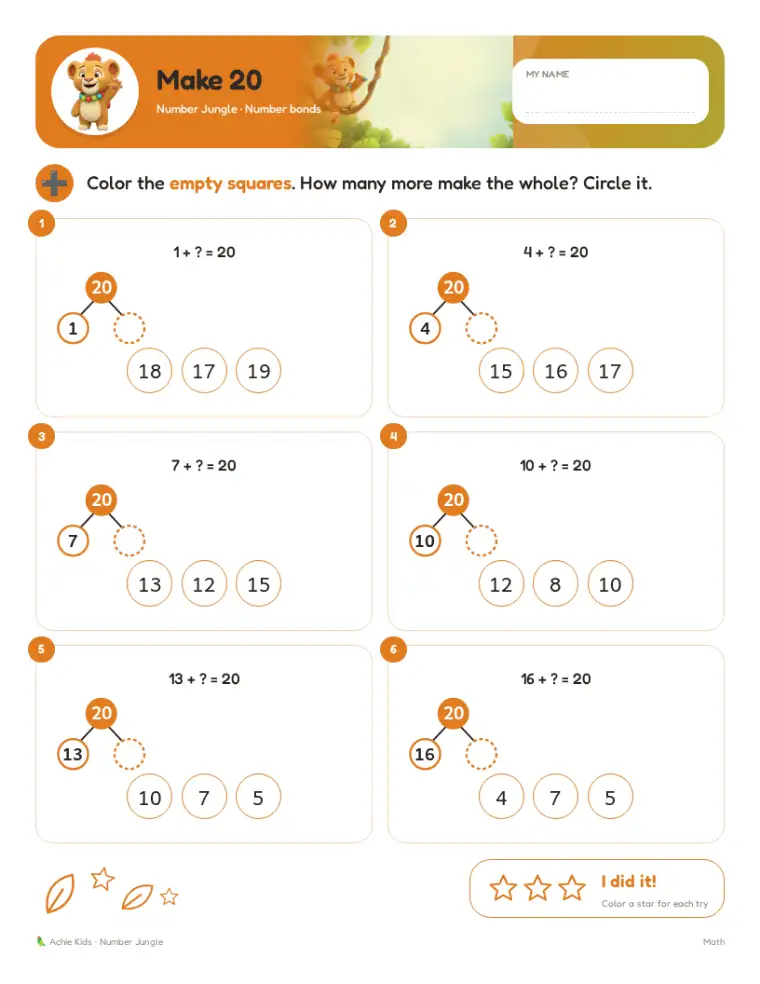
Six part–whole puzzles for 20: 1 + … = 20, 4 + … = 20 and 7 + … = 20. Use the pairs that make 10 to help: 3 + 7 = 10, so 13 + 7 = 20.
Ages 6–7 · 2 pages · color + ink-saver
Math
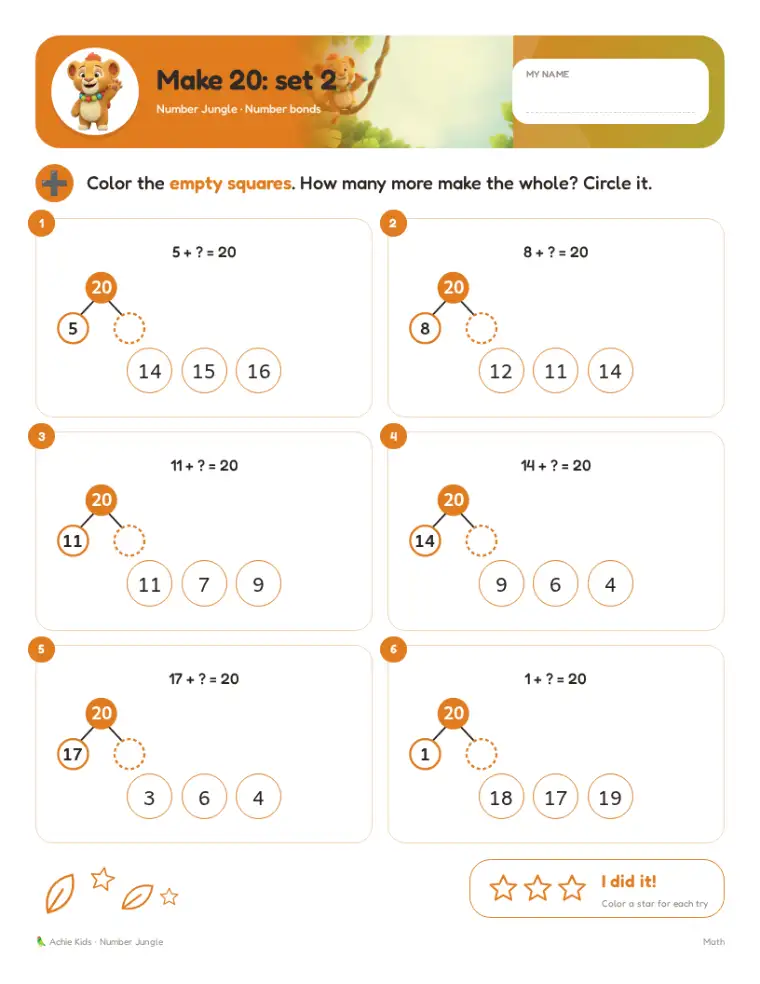
Six part–whole puzzles for 20: 5 + … = 20, 8 + … = 20 and 11 + … = 20. Use the pairs that make 10 to help: 3 + 7 = 10, so 13 + 7 = 20.
Ages 6–7 · 2 pages · color + ink-saver
 Free
Math
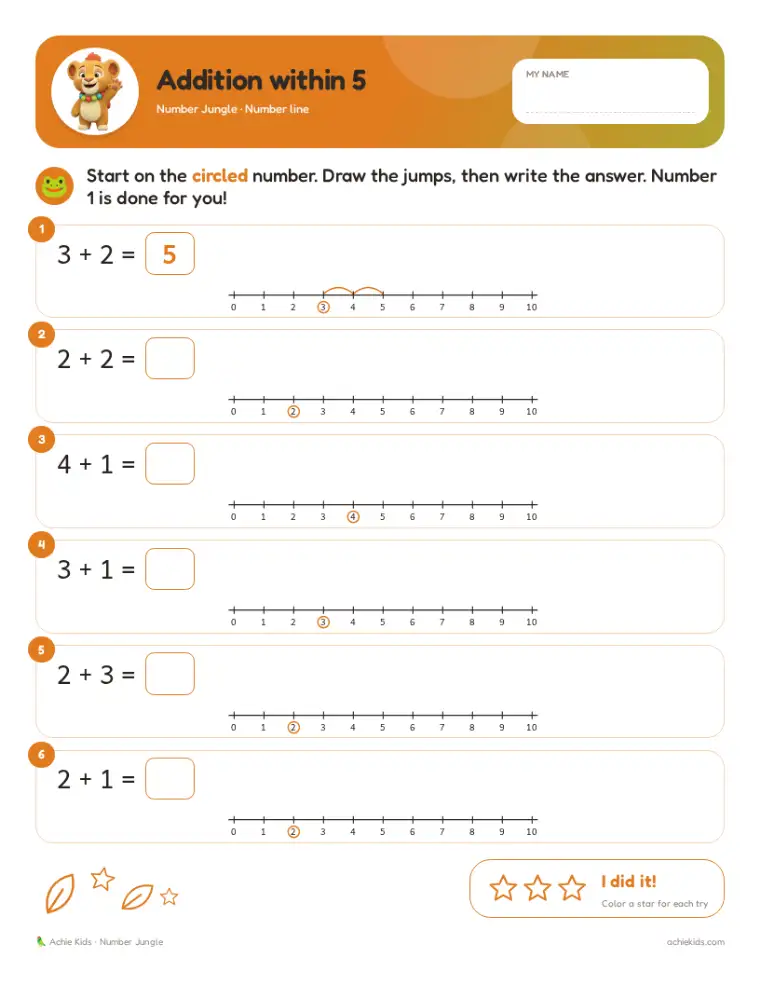
Six addition problems within 5 — 3 + 2, 2 + 2 and 4 + 1… — each with its own number line. Start on the circled number and draw the hops forward; the first one is done as an example and the answers are on page 2.
Ages 4–5 · 2 pages · color + ink-saver
Math
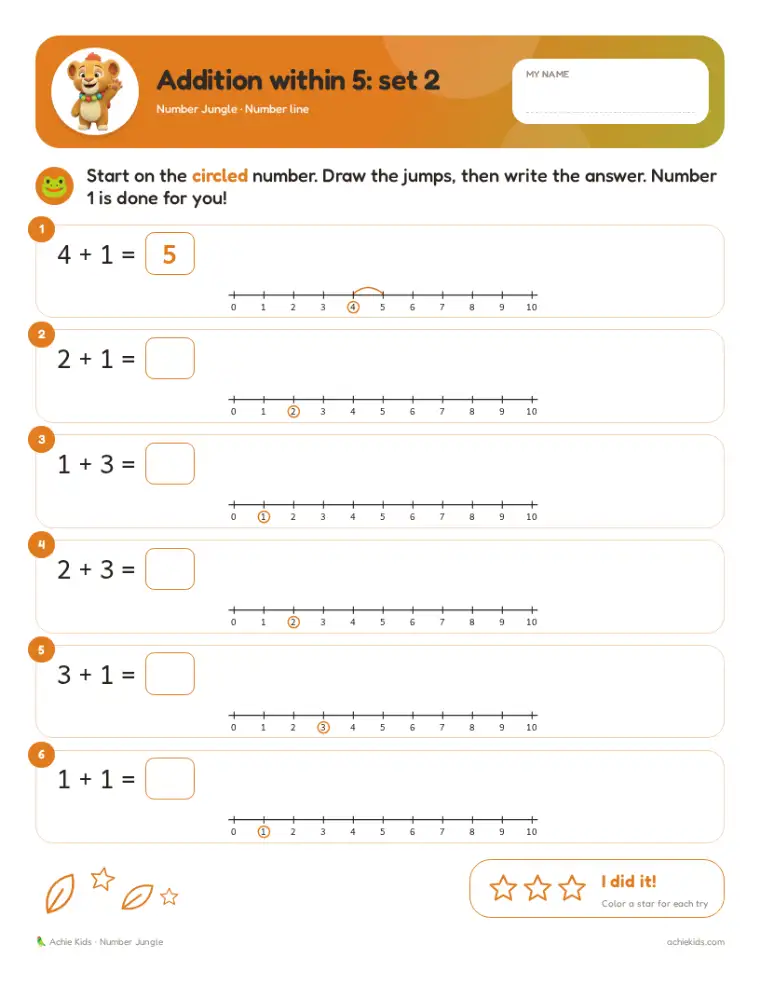
Six addition problems within 5 — 4 + 1, 2 + 1 and 1 + 3… — each with its own number line. Start on the circled number and draw the hops forward; the first one is done as an example and the answers are on page 2.
Ages 4–5 · 2 pages · color + ink-saver
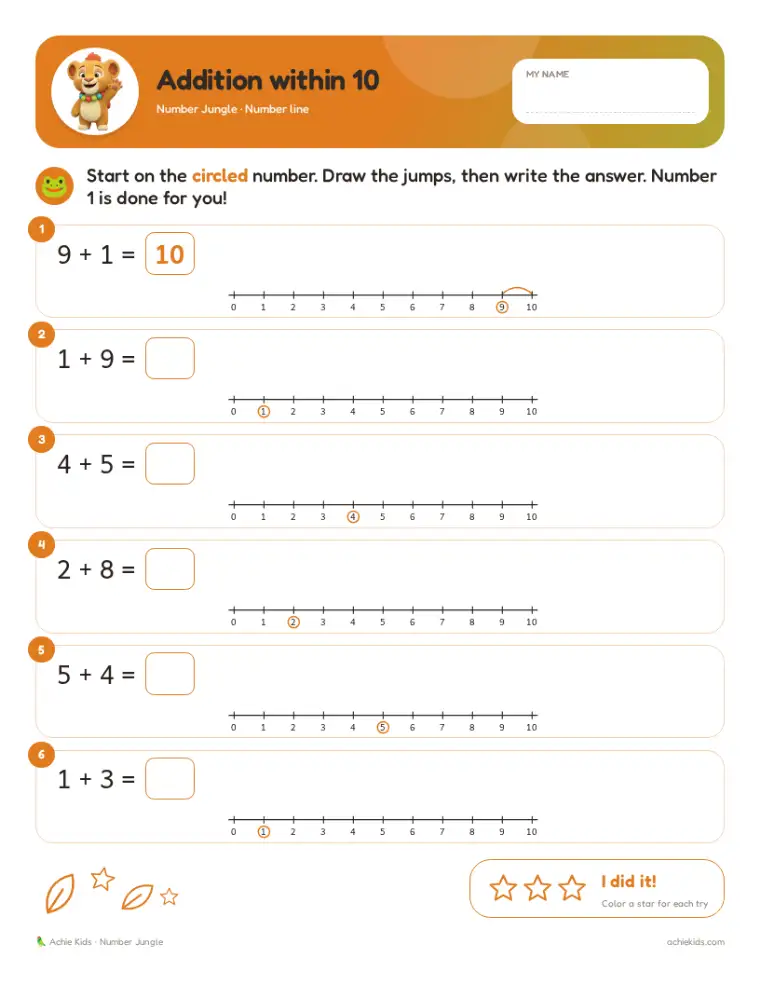
Math
Six addition problems within 10 — 9 + 1, 1 + 9 and 4 + 5… — each with its own number line. Start on the circled number and draw the hops forward; the first one is done as an example and the answers are on page 2.
Ages 5–6 · 2 pages · color + ink-saver
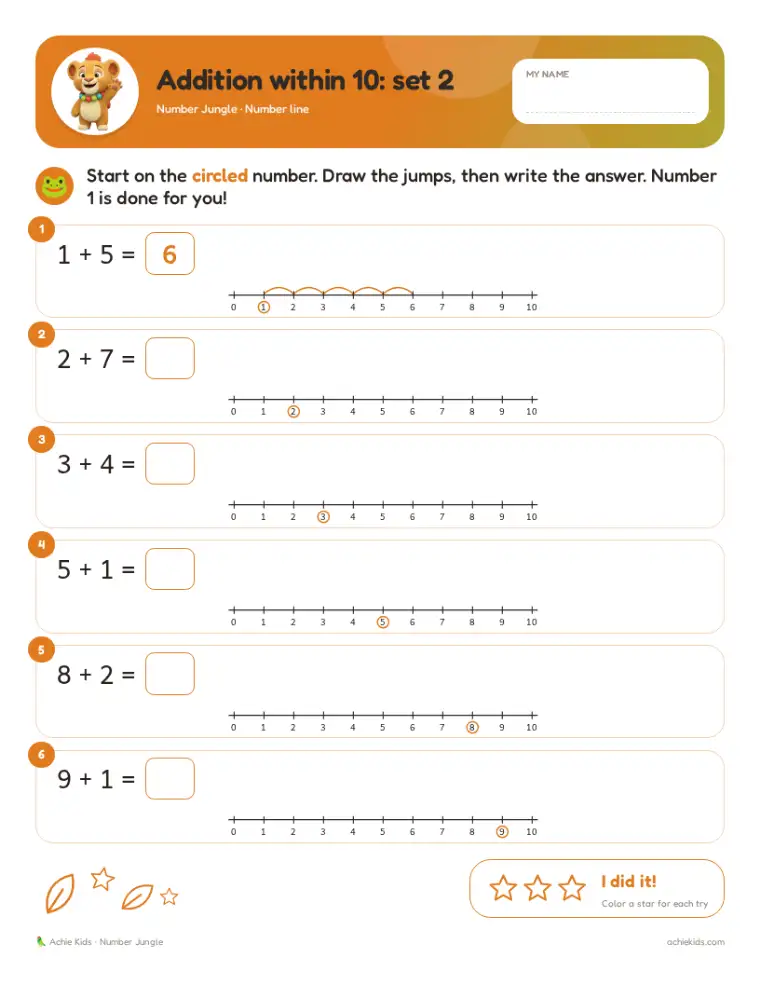
Math
Six addition problems within 10 — 1 + 5, 2 + 7 and 3 + 4… — each with its own number line. Start on the circled number and draw the hops forward; the first one is done as an example and the answers are on page 2.
Ages 5–6 · 2 pages · color + ink-saver
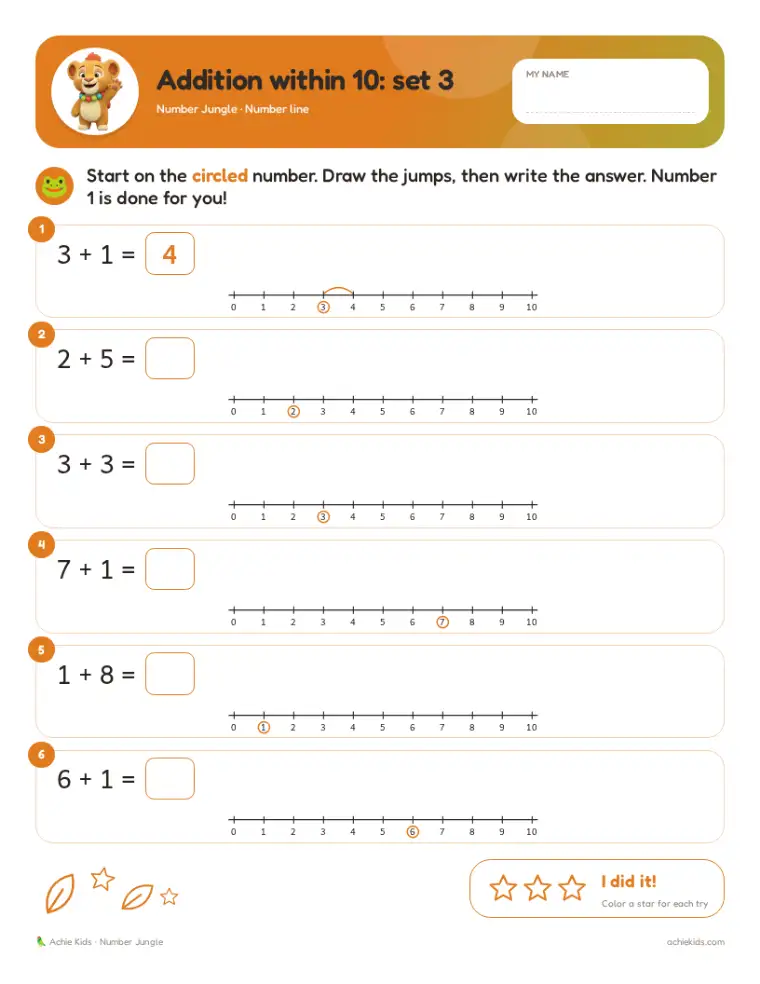
Math
Six addition problems within 10 — 3 + 1, 2 + 5 and 3 + 3… — each with its own number line. Start on the circled number and draw the hops forward; the first one is done as an example and the answers are on page 2.
Ages 5–6 · 2 pages · color + ink-saver
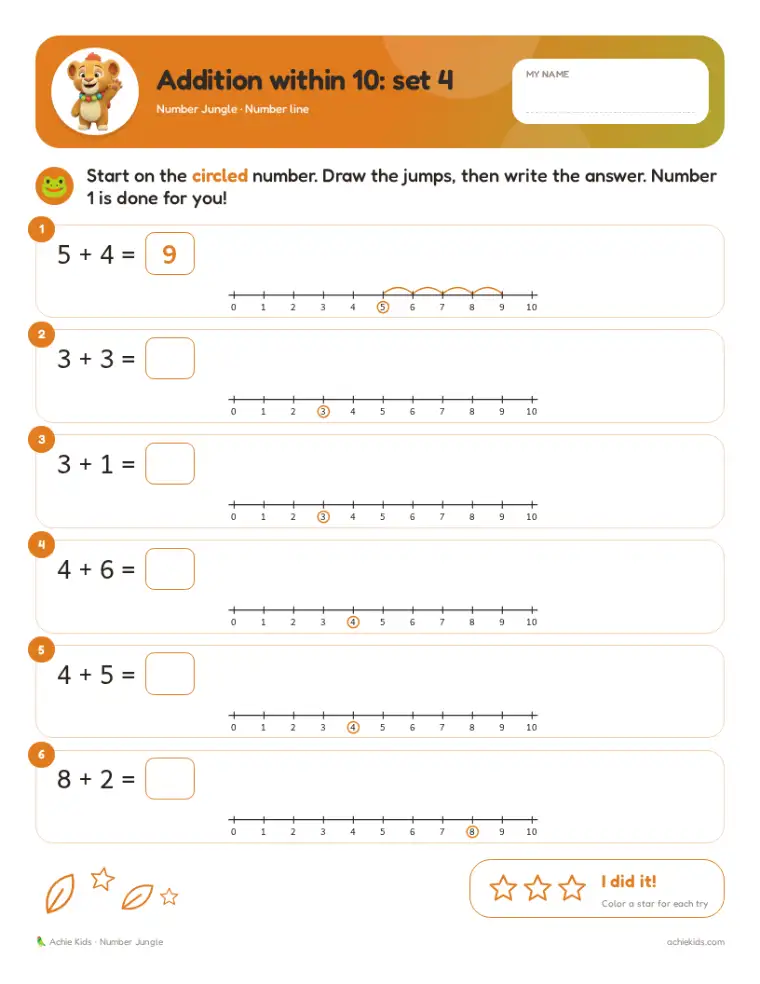
Math
Six addition problems within 10 — 5 + 4, 3 + 3 and 3 + 1… — each with its own number line. Start on the circled number and draw the hops forward; the first one is done as an example and the answers are on page 2.
Ages 5–6 · 2 pages · color + ink-saver
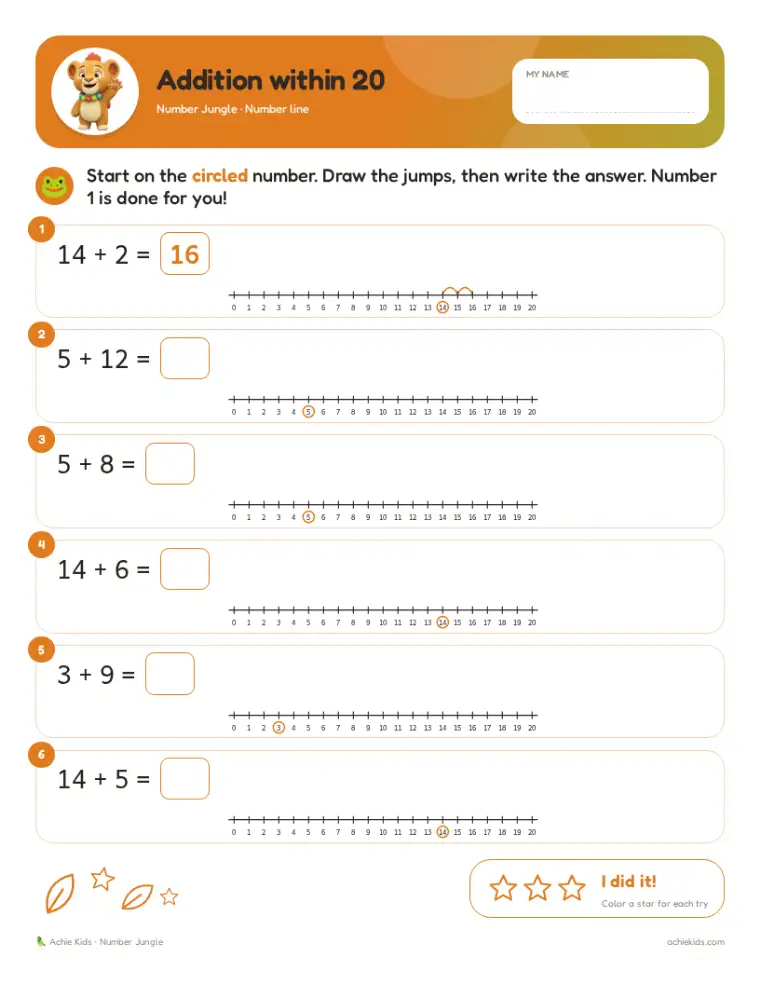 Free
Math
Six addition problems within 20 — 14 + 2, 5 + 12 and 5 + 8… — each with its own number line. Start on the circled number and draw the hops forward; the first one is done as an example and the answers are on page 2.
Ages 6–7 · 2 pages · color + ink-saver
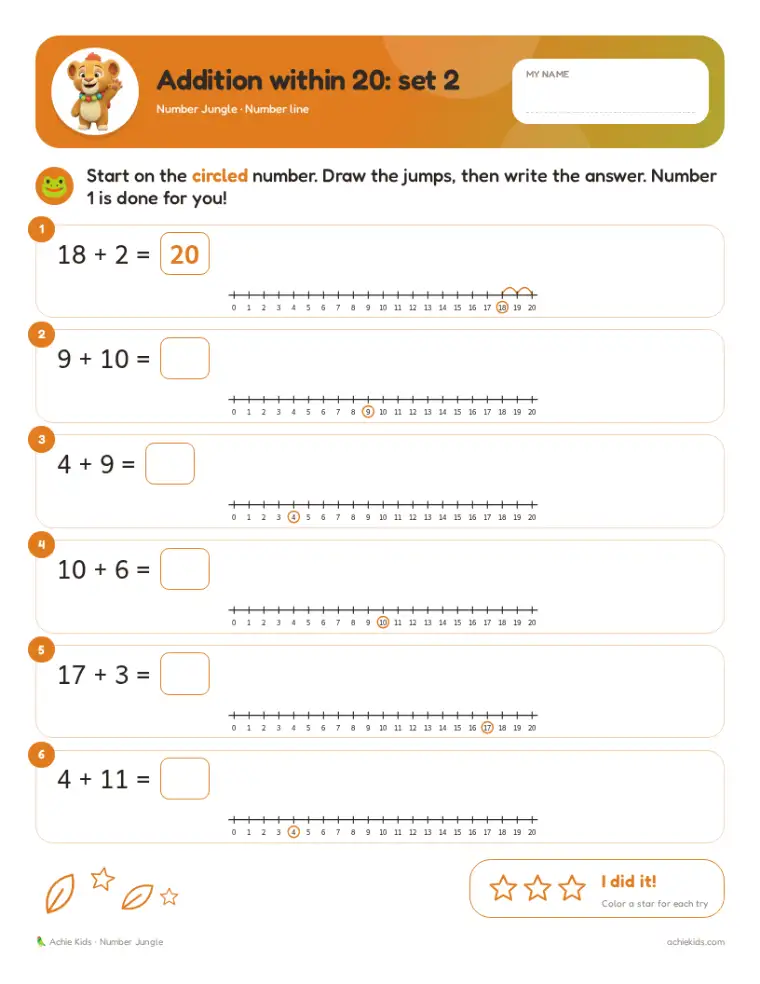
Math
Six addition problems within 20 — 18 + 2, 9 + 10 and 4 + 9… — each with its own number line. Start on the circled number and draw the hops forward; the first one is done as an example and the answers are on page 2.
Ages 6–7 · 2 pages · color + ink-saver
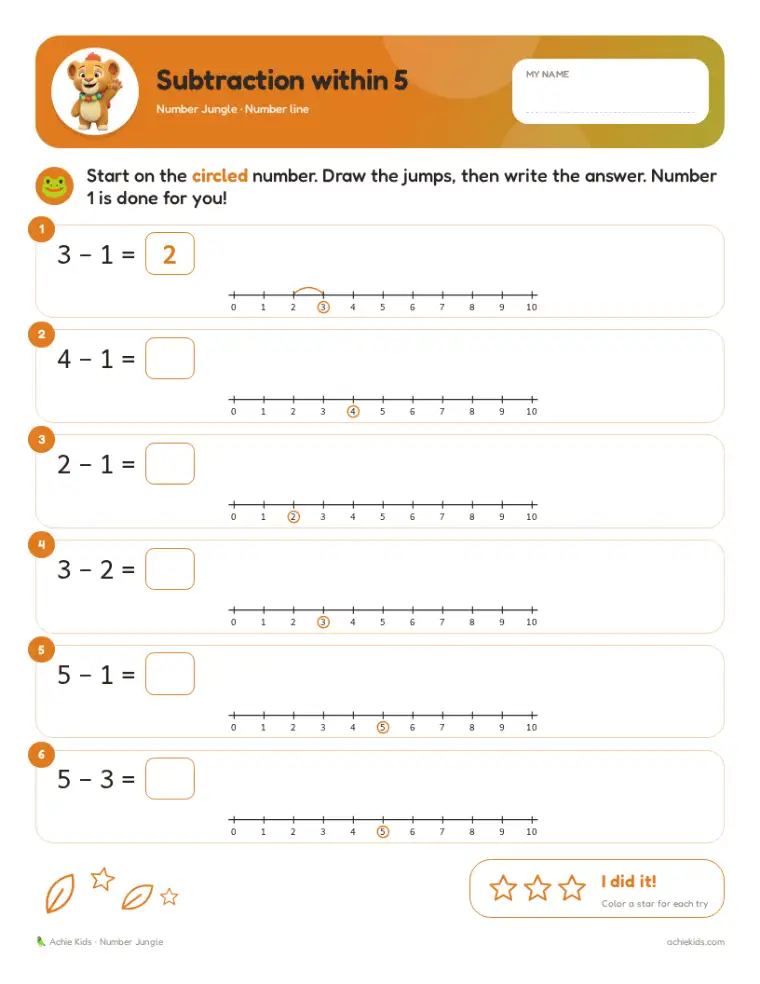 Free
Math
Six subtraction problems within 5 — 3 − 1, 4 − 1 and 2 − 1… — each with its own number line. Start on the circled number and draw the hops back; the first one is done as an example and the answers are on page 2.
Ages 4–5 · 2 pages · color + ink-saver
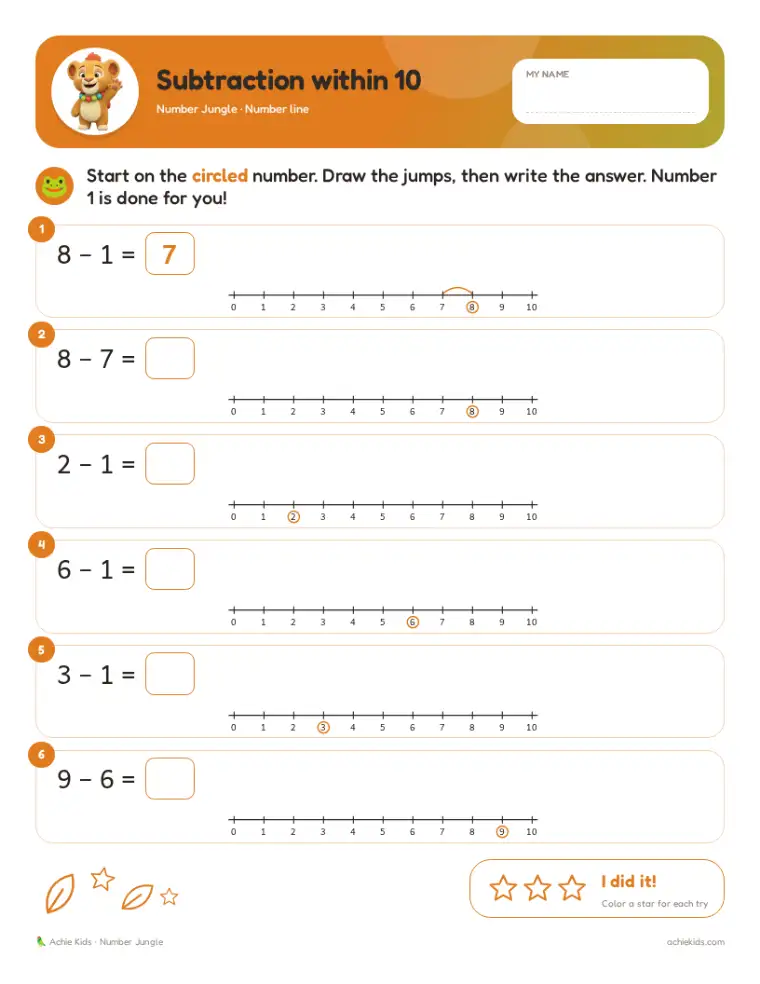
Math
Six subtraction problems within 10 — 8 − 1, 8 − 7 and 2 − 1… — each with its own number line. Start on the circled number and draw the hops back; the first one is done as an example and the answers are on page 2.
Ages 5–6 · 2 pages · color + ink-saver
Math
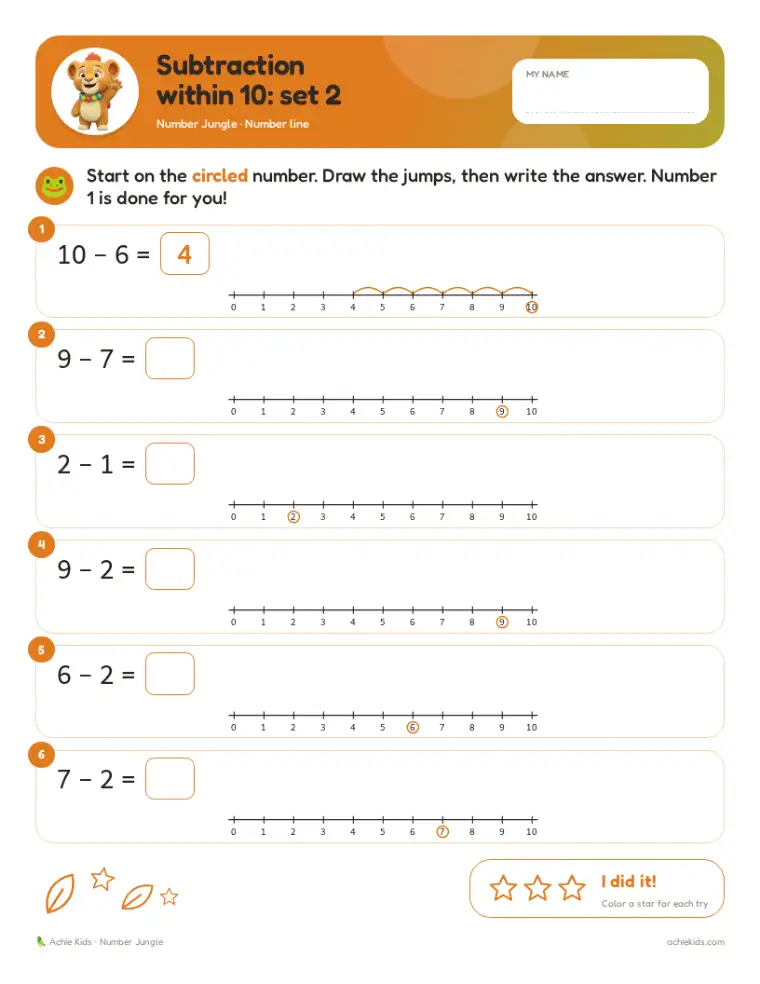
Six subtraction problems within 10 — 10 − 6, 9 − 7 and 2 − 1… — each with its own number line. Start on the circled number and draw the hops back; the first one is done as an example and the answers are on page 2.
Ages 5–6 · 2 pages · color + ink-saver
Math
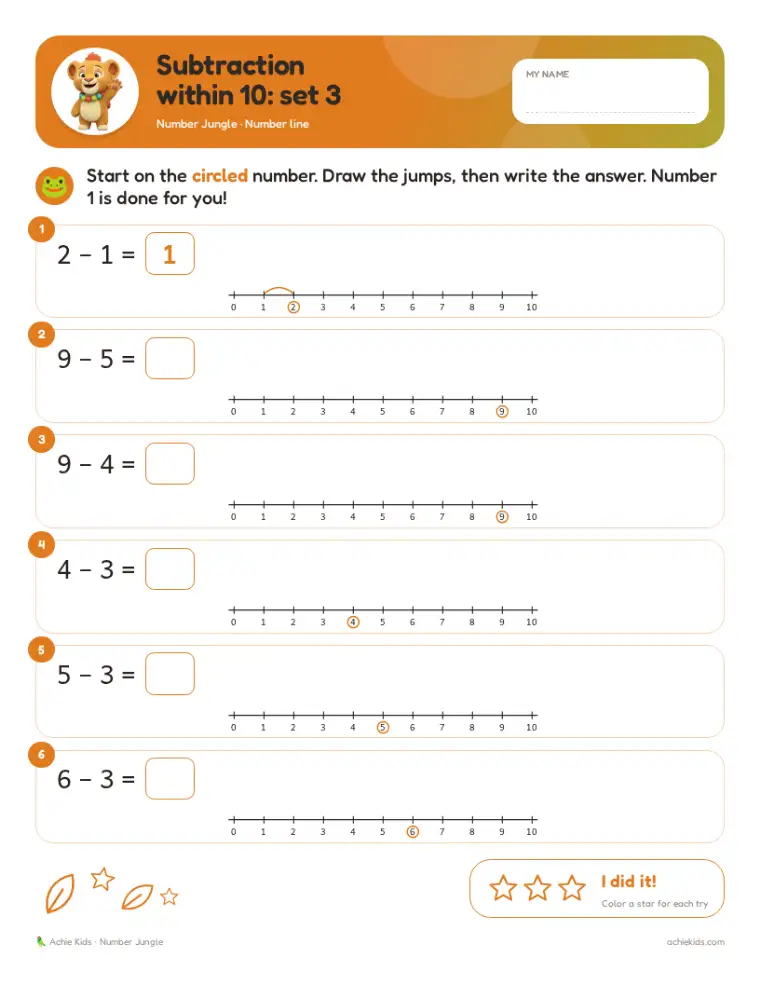
Six subtraction problems within 10 — 2 − 1, 9 − 5 and 9 − 4… — each with its own number line. Start on the circled number and draw the hops back; the first one is done as an example and the answers are on page 2.
Ages 5–6 · 2 pages · color + ink-saver
 Free
Math
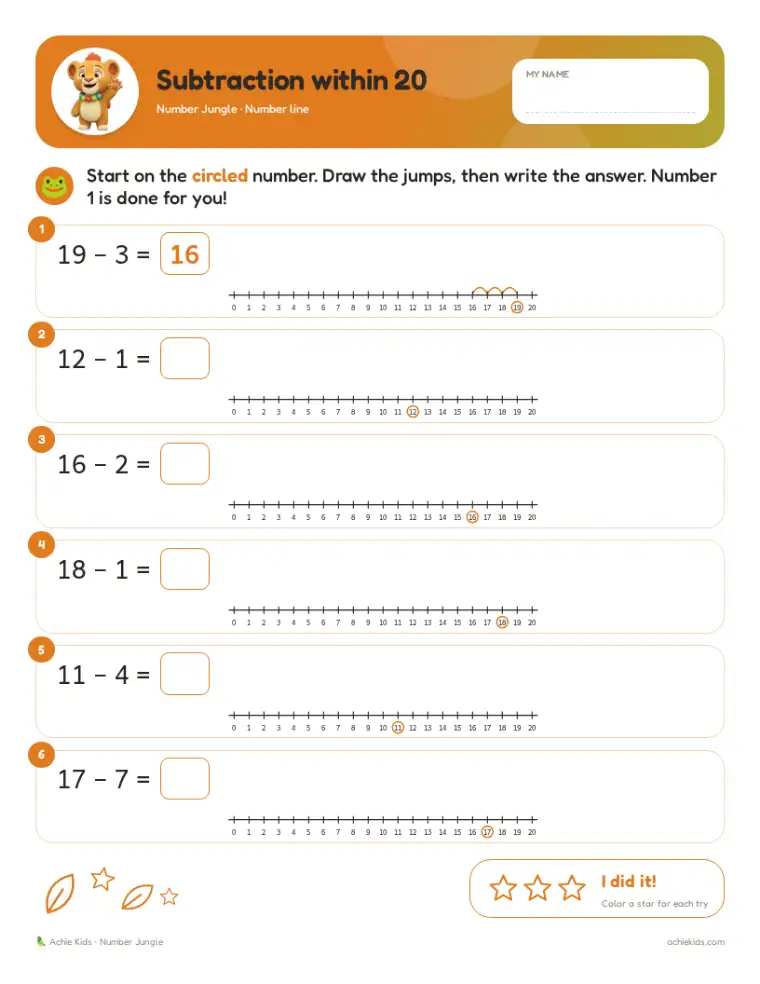
Six subtraction problems within 20 — 19 − 3, 12 − 1 and 16 − 2… — each with its own number line. Start on the circled number and draw the hops back; the first one is done as an example and the answers are on page 2.
Ages 6–7 · 2 pages · color + ink-saver
Math
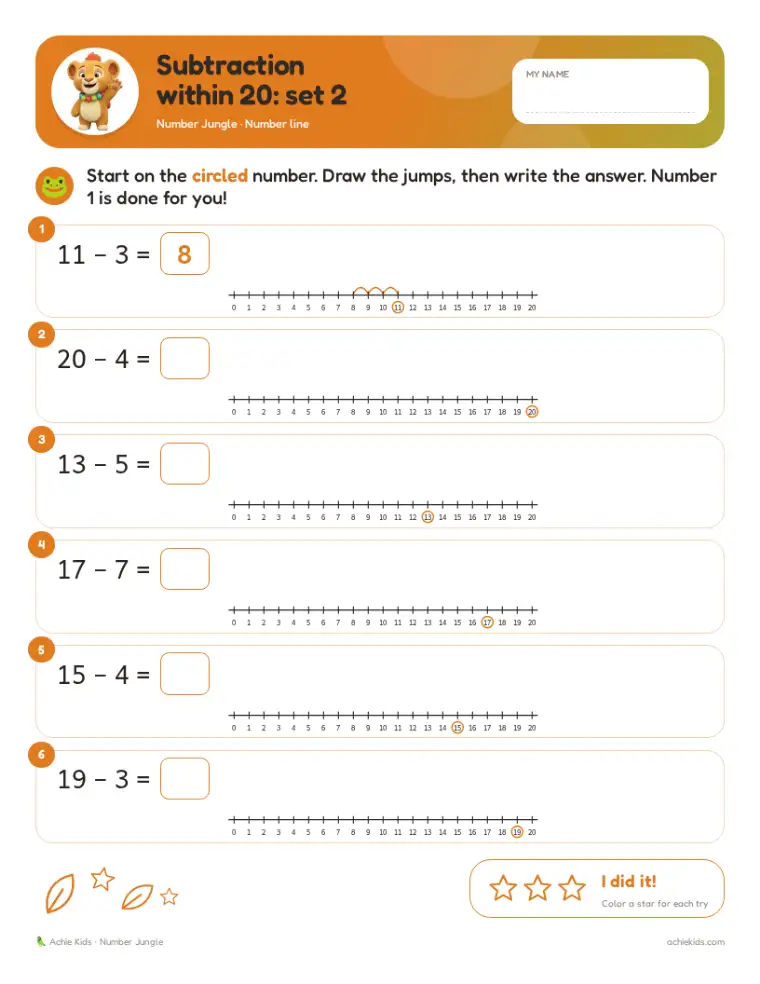
Six subtraction problems within 20 — 11 − 3, 20 − 4 and 13 − 5… — each with its own number line. Start on the circled number and draw the hops back; the first one is done as an example and the answers are on page 2.
Ages 6–7 · 2 pages · color + ink-saver
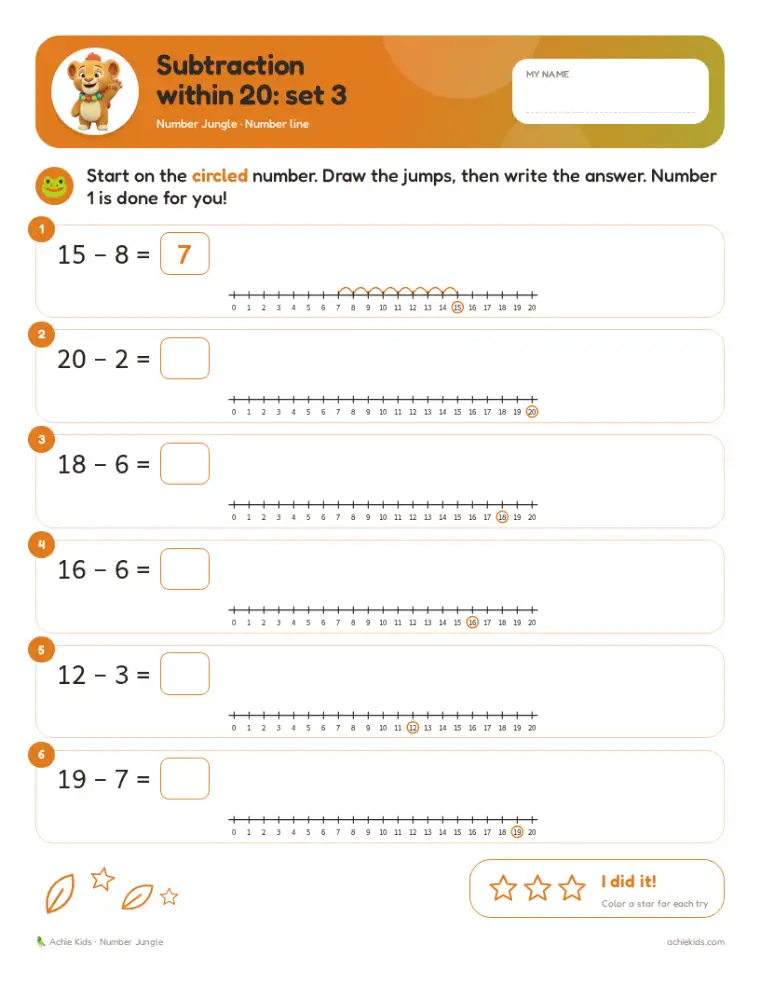
Math
Six subtraction problems within 20 — 15 − 8, 20 − 2 and 18 − 6… — each with its own number line. Start on the circled number and draw the hops back; the first one is done as an example and the answers are on page 2.
Ages 6–7 · 2 pages · color + ink-saver
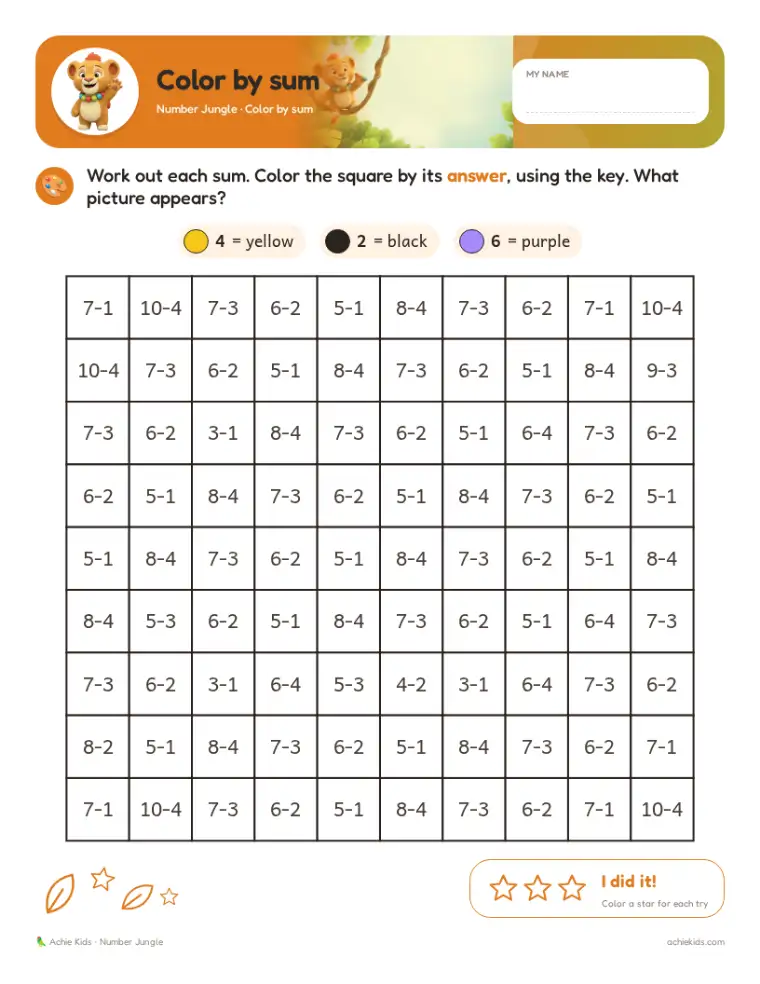
Math
A mystery picture hidden in subtraction facts such as 5-1, 6-2 and 7-3. Solve each square, color it by its answer using the key, and a picture appears — fluency practice that feels like art.
Ages 5–6 · 2 pages · color + ink-saver
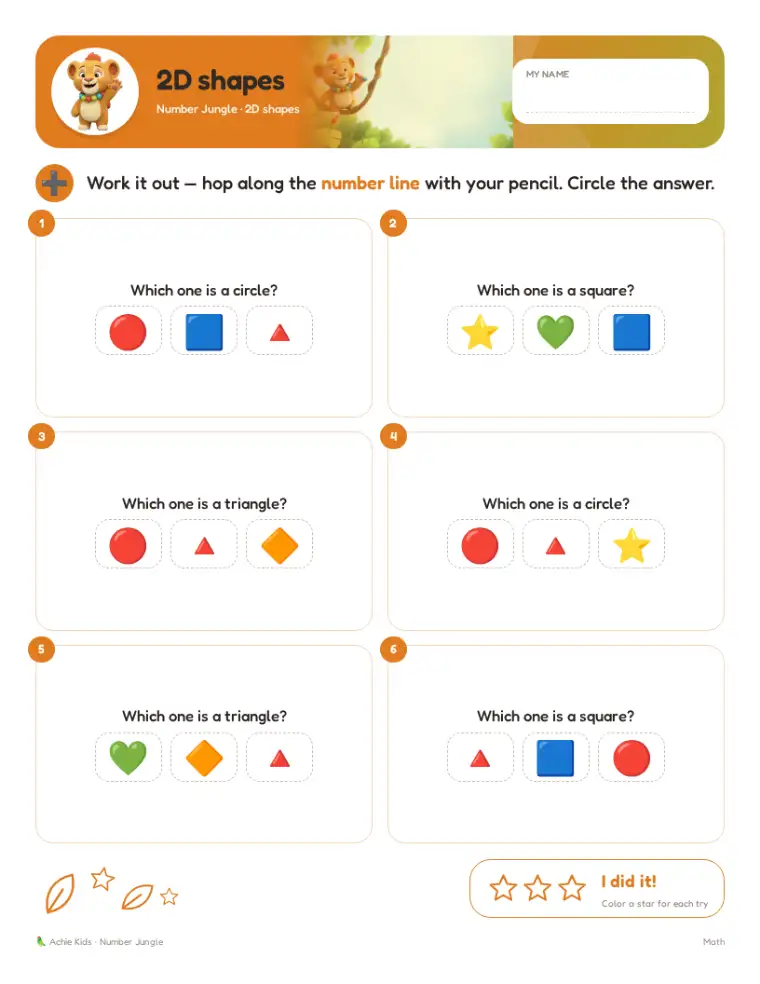 Free
Math
Six shape hunts: find the circle, square and triangle among the pictures and circle it, then color the shapes in. Name each shape and talk about its sides and corners as you go.
Ages 4–5 · 2 pages · color + ink-saver
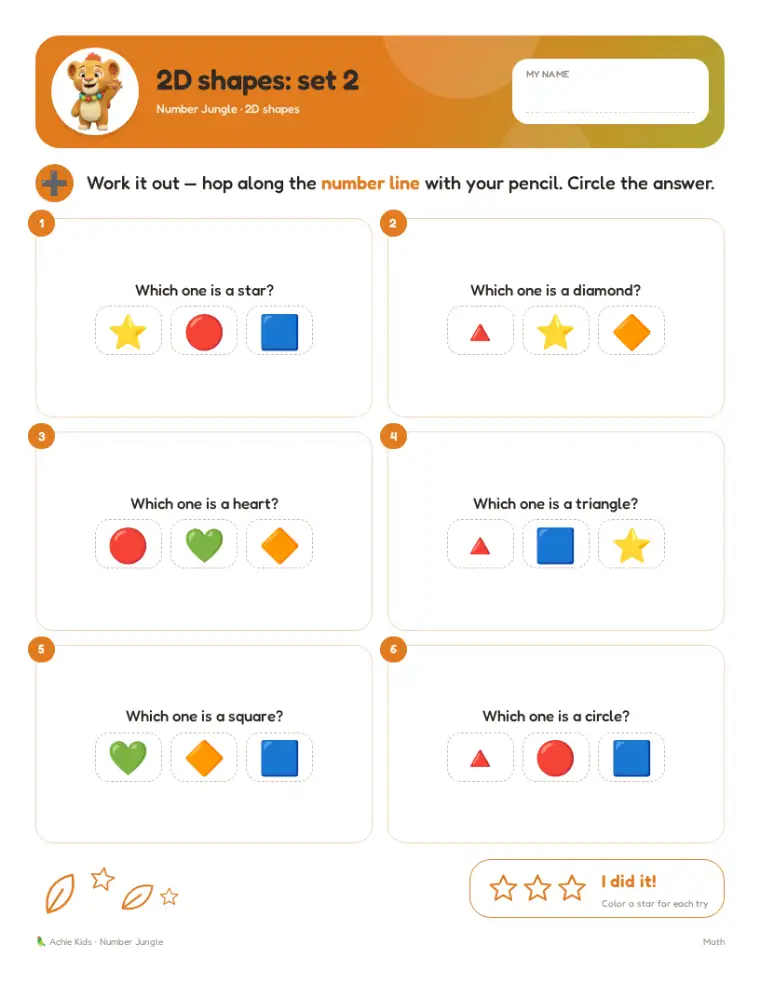
Math
Six shape hunts: find the star, diamond, heart and triangle among the pictures and circle it, then color the shapes in. Name each shape and talk about its sides and corners as you go.
Ages 4–5 · 2 pages · color + ink-saver
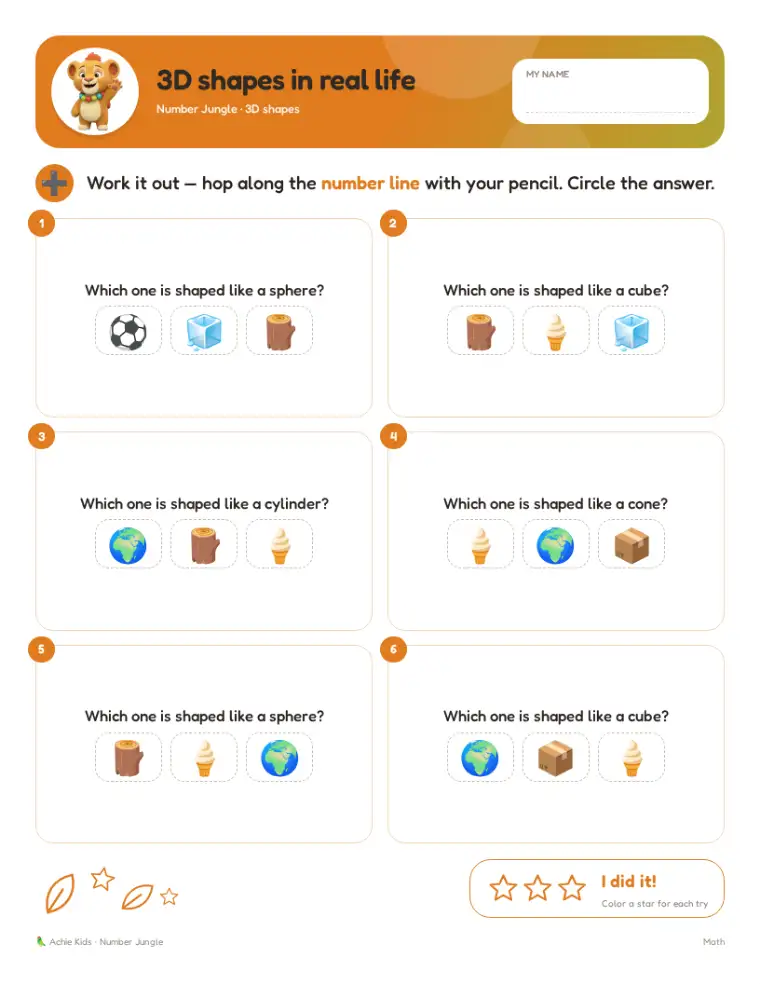
Math
3D shapes in everyday things: which is shaped like a sphere, cube, cylinder and cone? Six picture puzzles with balls, dice, tins and ice cream cones, to circle and talk about.
Ages 5–6 · 2 pages · color + ink-saver
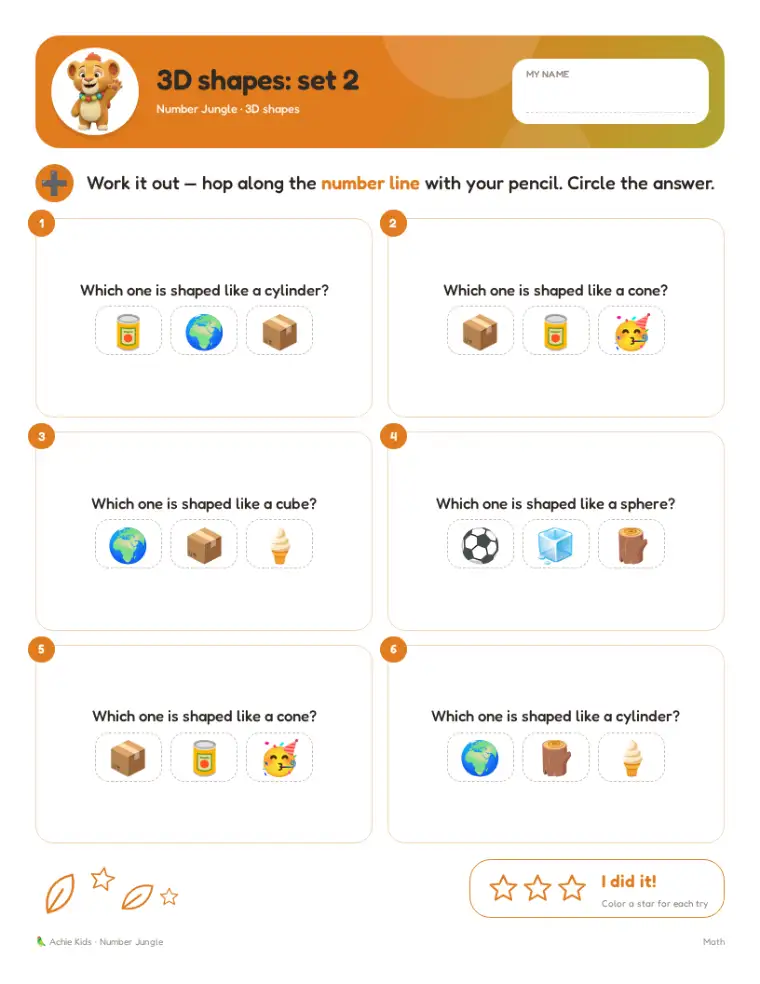
Math
3D shapes in everyday things: which is shaped like a cylinder, cone, cube and sphere? Six picture puzzles with balls, dice, tins and ice cream cones, to circle and talk about.
Ages 5–6 · 2 pages · color + ink-saver
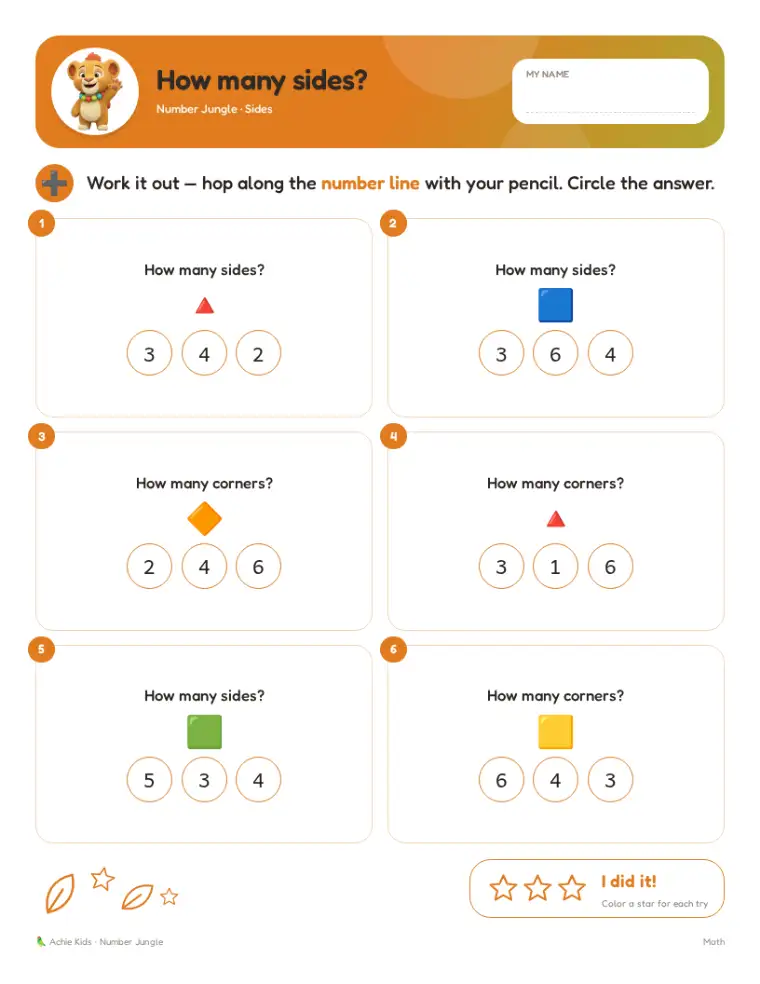
Math
Count the sides of six shapes — triangles, squares and diamonds — and circle the number. Counting sides and corners is how children learn to tell shapes apart, and how they are named.
Ages 5–6 · 2 pages · color + ink-saver

Math
Five rows of shapes and shaped things. Three match and one does not — a triangle among circles, a cube among balls. Circle the odd one out and say why.
Ages 4–5 · 2 pages · color + ink-saver
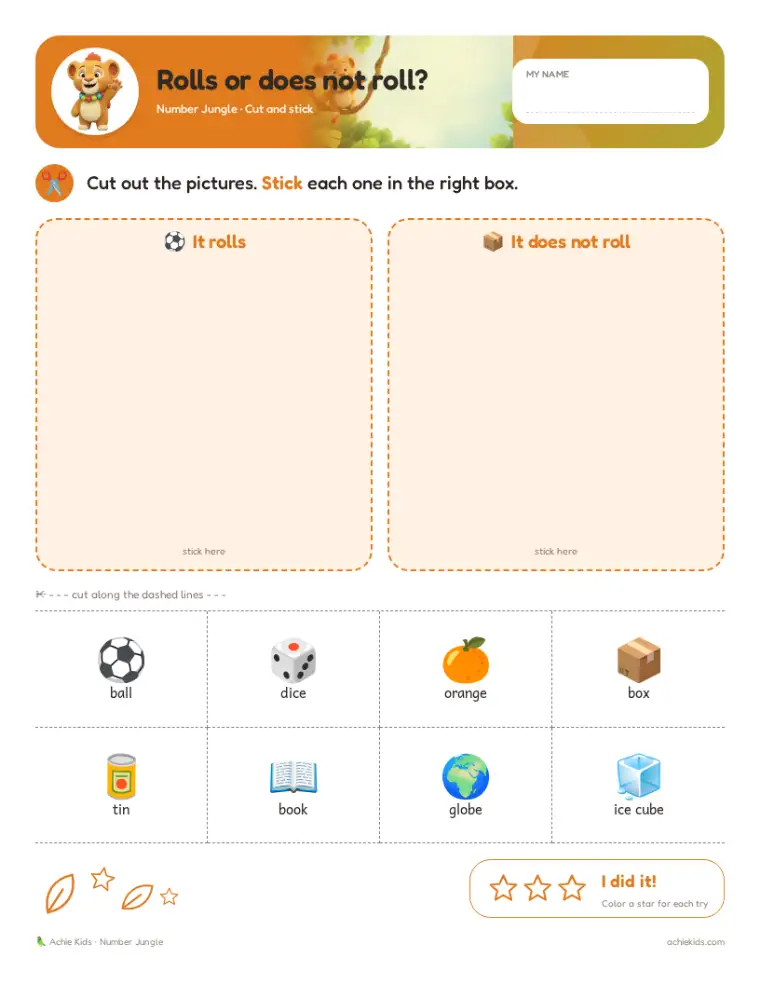
Math
Cut out eight everyday things — balls, tins, boxes and dice — and sort them: does it roll, or not? A hands-on way into curved and flat faces on 3D shapes.
Ages 4–5 · 2 pages · color + ink-saver
 Free
Math
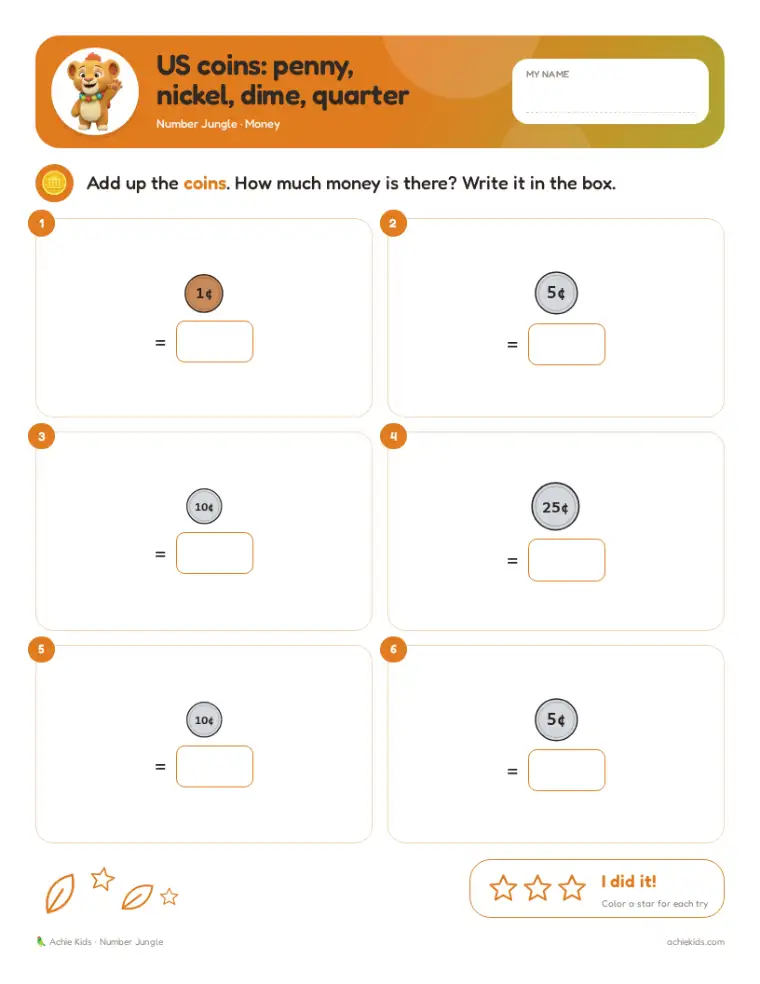
Meet the US coins: penny (1¢), nickel (5¢), dime (10¢) and quarter (25¢). Six cards with one coin each — write its value. The dime is the smallest coin but worth more than a nickel!
Ages 5–6 · 2 pages · color + ink-saver
Math
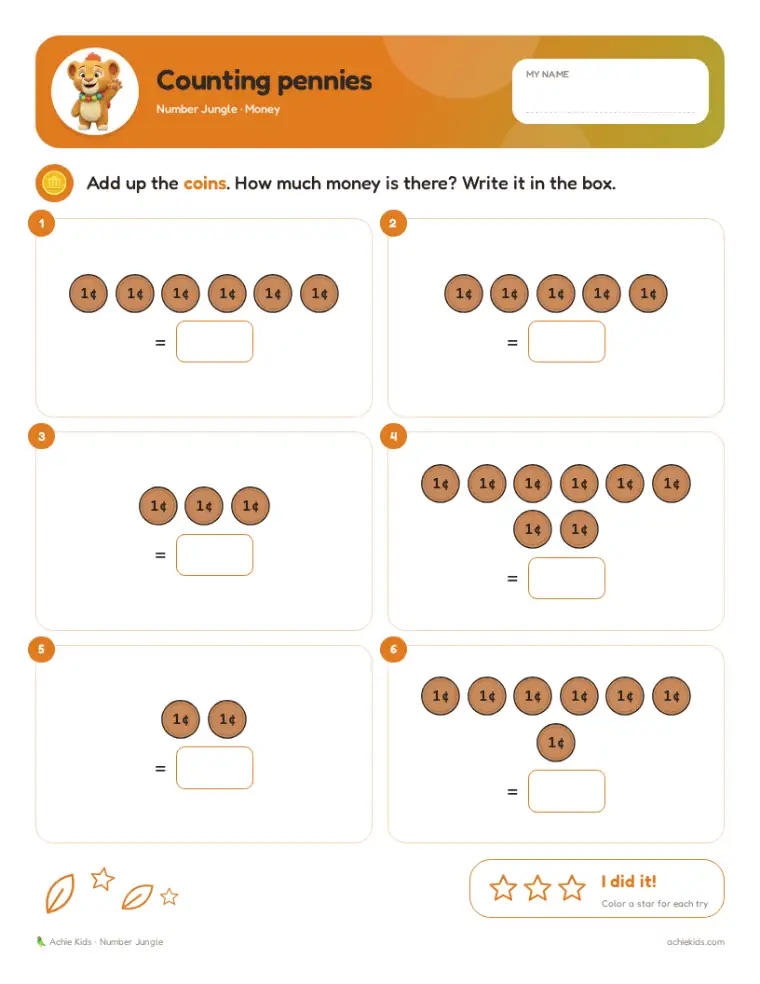
Count pennies up to 10¢. Six groups of 1¢ coins to touch and count — the first step to counting money.
Ages 5–6 · 2 pages · color + ink-saver
Math
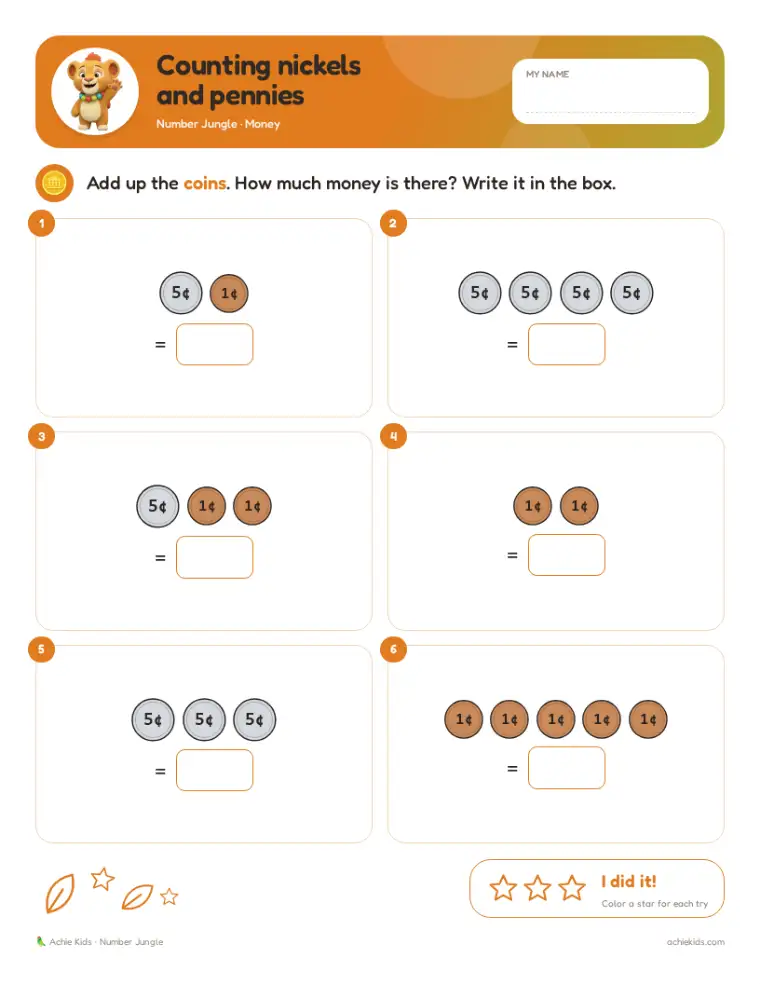
Add nickels and pennies up to 25¢. Count the nickels by 5s first, then count on the pennies: 5, 10, 11, 12…
Ages 5–6 · 2 pages · color + ink-saver
Math
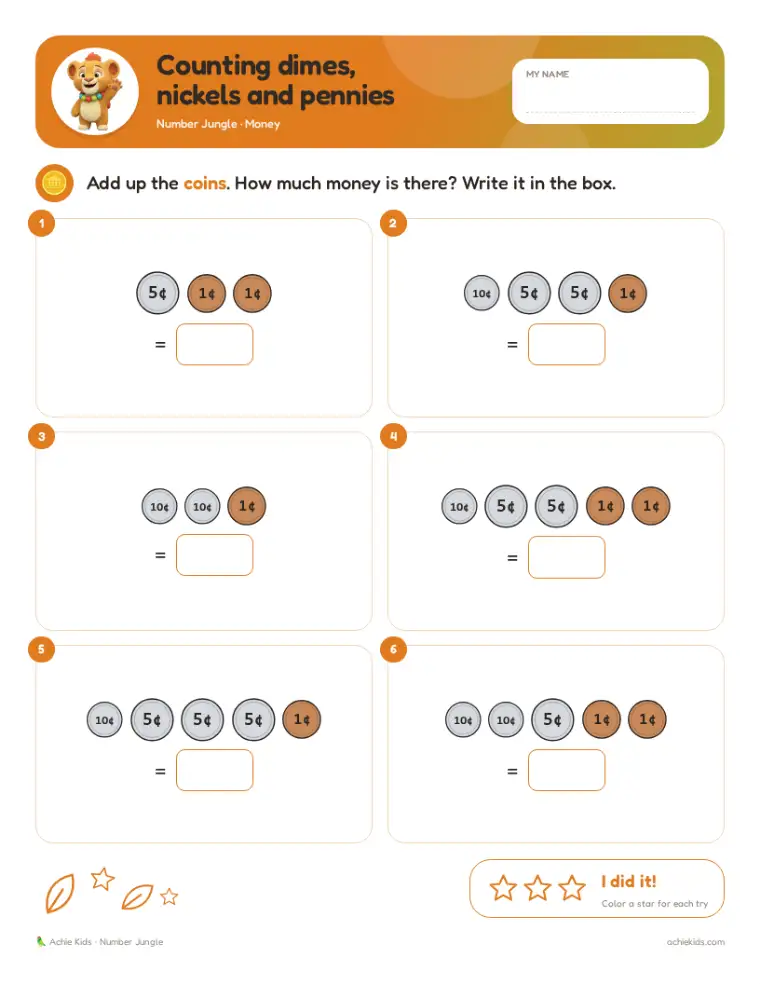
Add dimes, nickels and pennies up to 50¢. Count dimes by 10s, nickels by 5s and pennies by 1s.
Ages 6–7 · 2 pages · color + ink-saver

Math
Add quarters, dimes and nickels to make amounts up to 99¢ — a second-grade money skill (2.MD.C.8).
Ages 6–7 · 2 pages · color + ink-saver

Math
Count quarters: 25¢, 50¢, 75¢, one dollar! Six groups of quarters up to $2.00, to see that four quarters make a dollar.
Ages 6–7 · 2 pages · color + ink-saver
Math
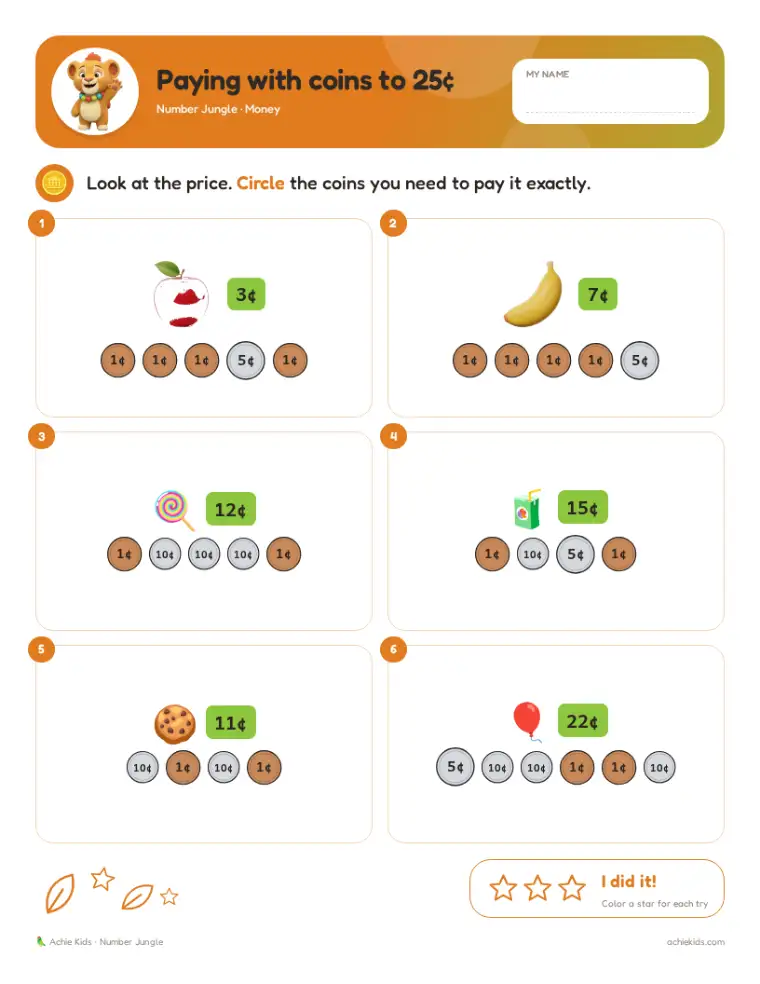
Six things to buy, from 3¢ to 22¢. Circle the coins that pay the exact price — there are spare coins, so choose carefully.
Ages 5–6 · 2 pages · color + ink-saver
Math
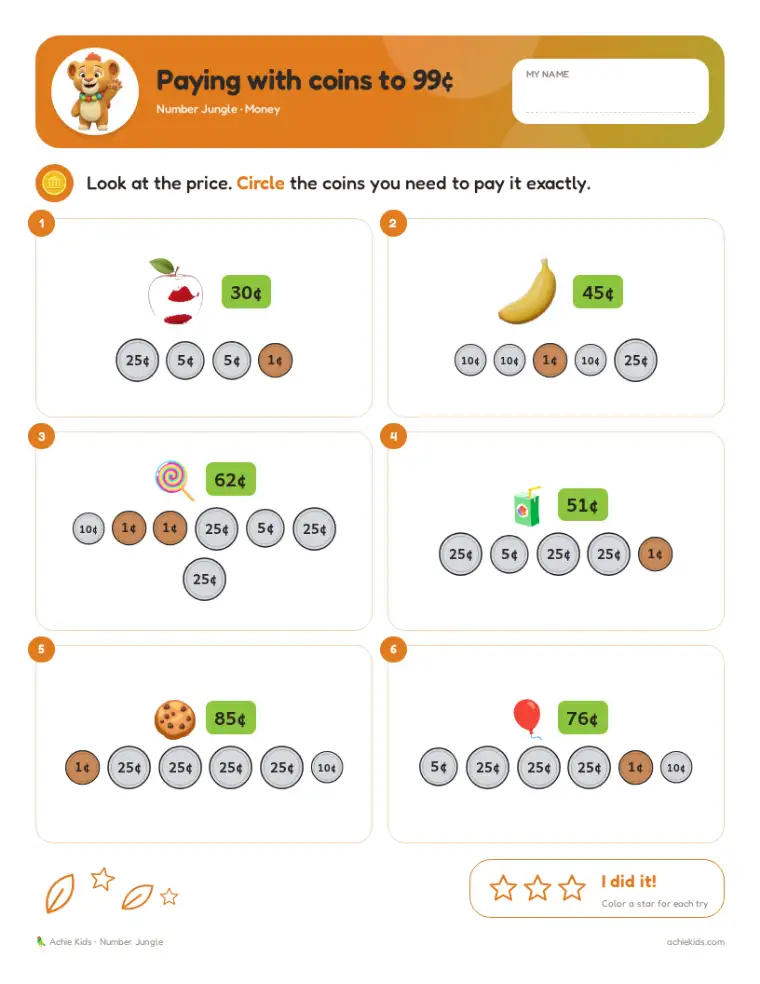
Six prices between 30¢ and 85¢ to pay exactly with quarters, dimes, nickels and pennies. Start with the quarters.
Ages 6–7 · 2 pages · color + ink-saver
 Free
Math
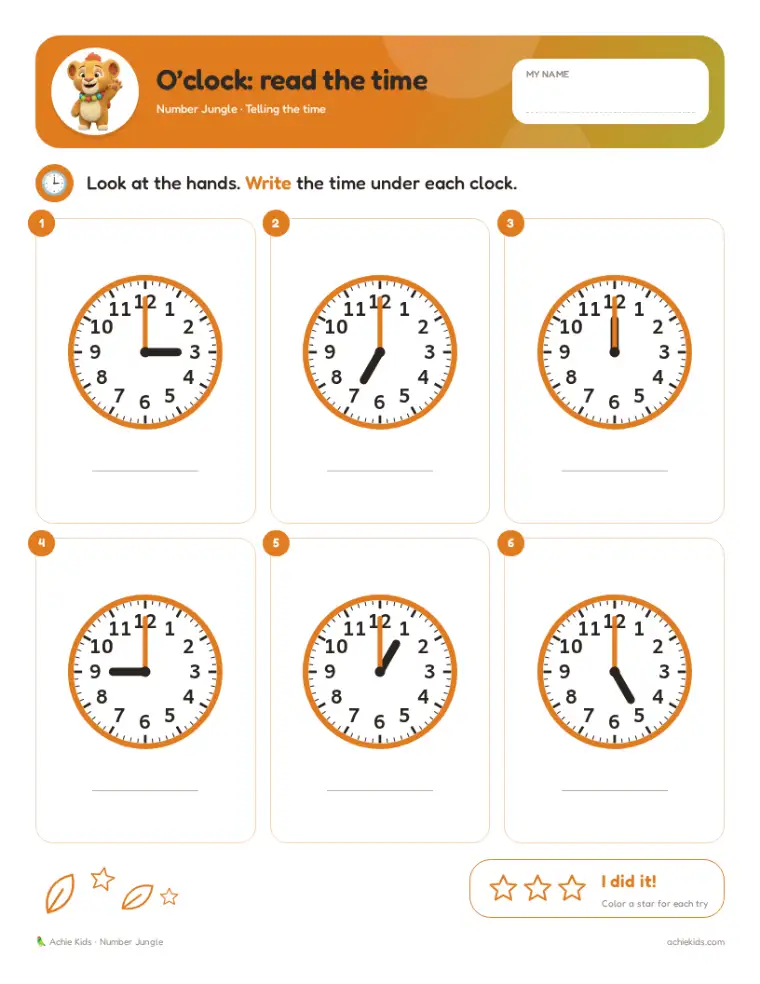
Six clocks to read: 3:00, 7:00 and 12:00… The short hand shows the hour and the long hand the minutes; the answer page shows every clock done.
Ages 5–6 · 2 pages · color + ink-saver
Math
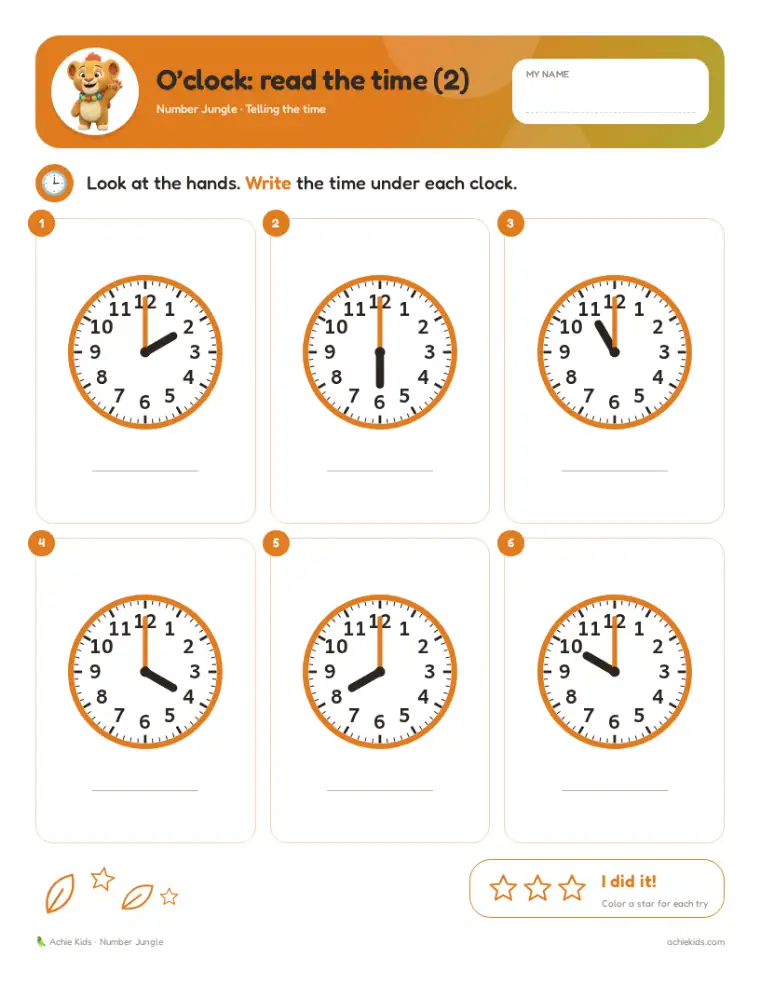
Six clocks to read: 2:00, 6:00 and 11:00… The short hand shows the hour and the long hand the minutes; the answer page shows every clock done.
Ages 5–6 · 2 pages · color + ink-saver
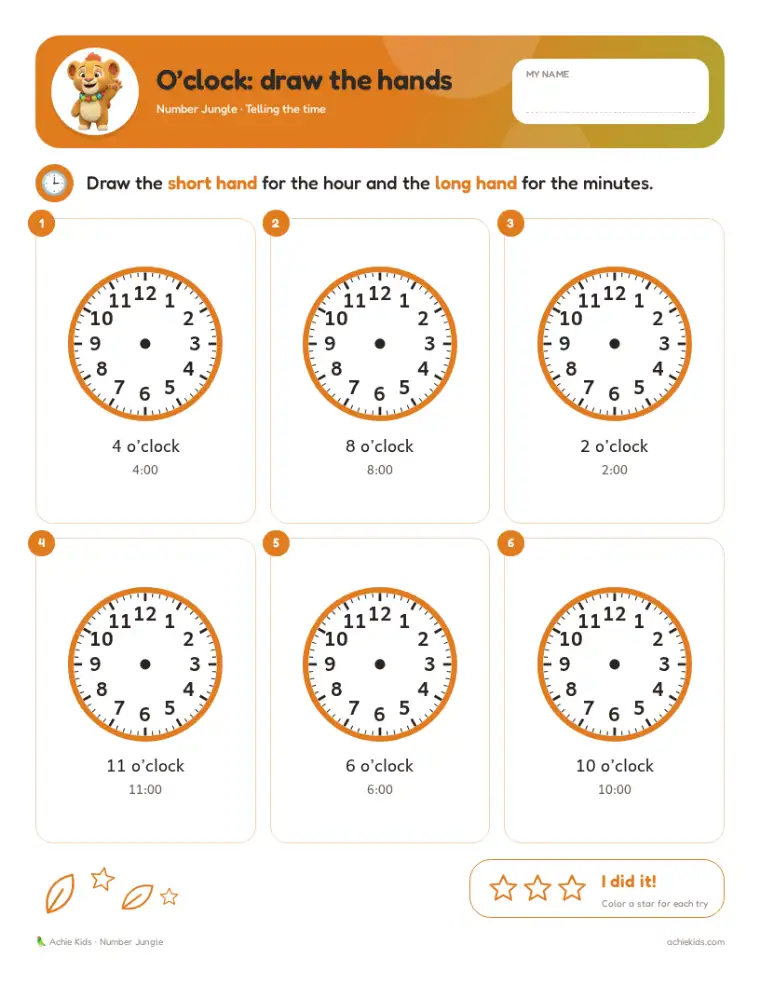
Math
Six clocks to draw the hands on: 4:00, 8:00 and 2:00… The short hand shows the hour and the long hand the minutes; the answer page shows every clock done.
Ages 5–6 · 2 pages · color + ink-saver
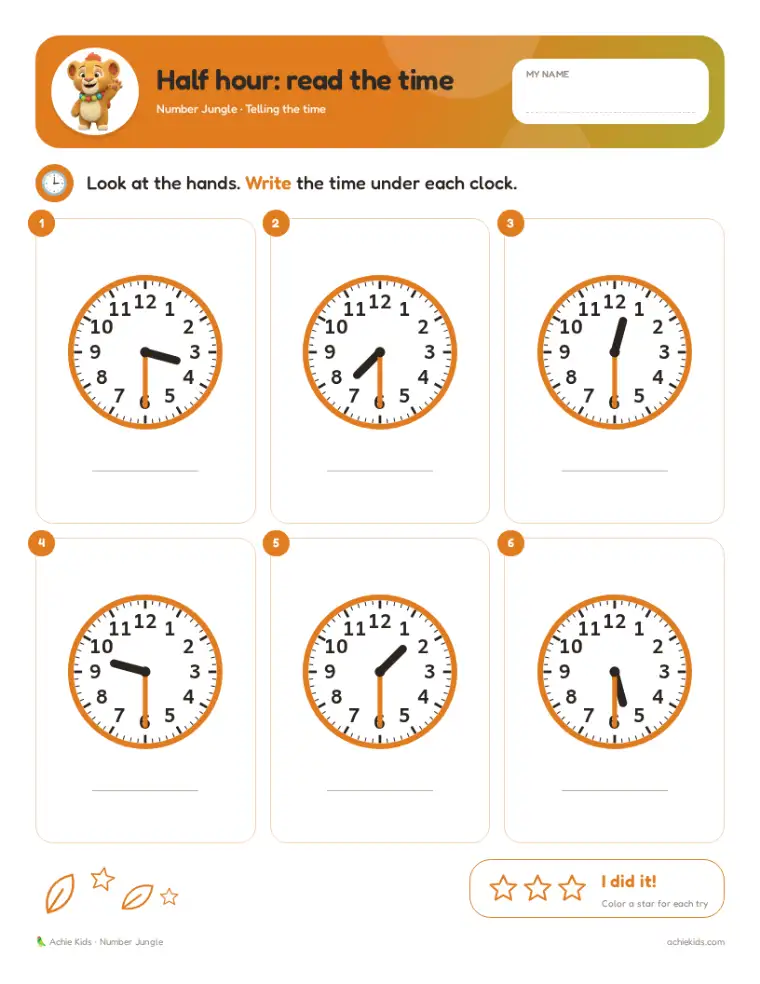
Math
Six clocks to read: 3:30, 7:30 and 12:30… The short hand shows the hour and the long hand the minutes; the answer page shows every clock done.
Ages 5–6 · 2 pages · color + ink-saver

Math
Six clocks to read: 2:00, 6:30 and 11:30… The short hand shows the hour and the long hand the minutes; the answer page shows every clock done.
Ages 5–6 · 2 pages · color + ink-saver
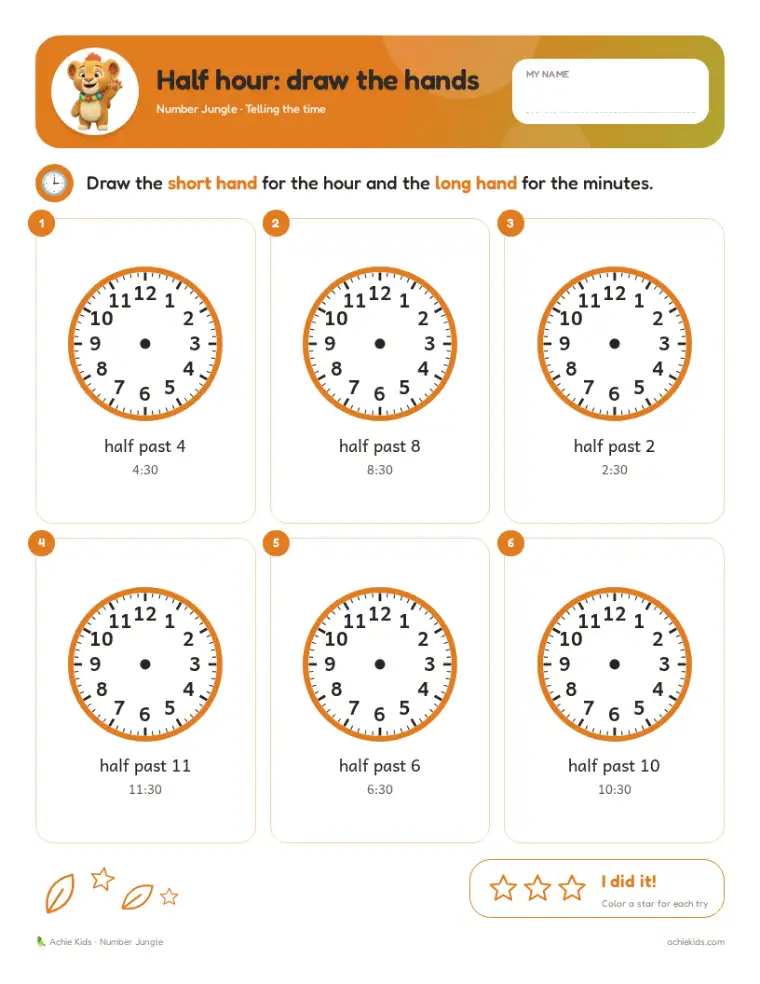
Math
Six clocks to draw the hands on: 4:30, 8:30 and 2:30… The short hand shows the hour and the long hand the minutes; the answer page shows every clock done.
Ages 5–6 · 2 pages · color + ink-saver

Math
Six clocks to read: 3:15, 7:15 and 12:15… The short hand shows the hour and the long hand the minutes; the answer page shows every clock done.
Ages 6–7 · 2 pages · color + ink-saver
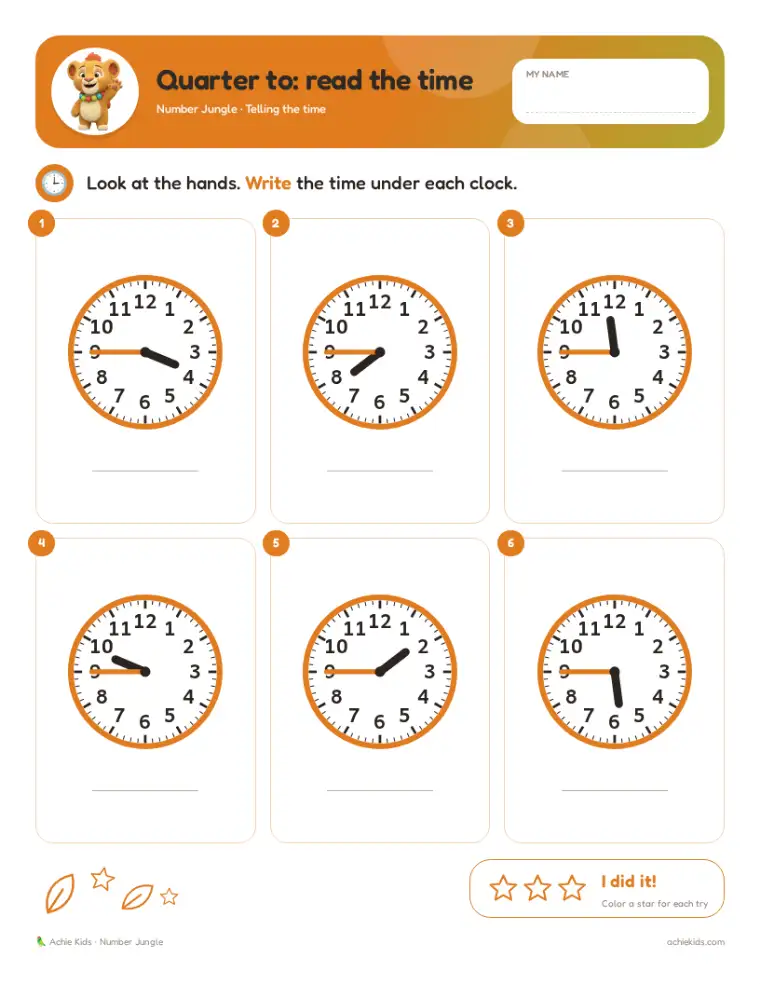
Math
Six clocks to read: 3:45, 7:45 and 11:45… The short hand shows the hour and the long hand the minutes; the answer page shows every clock done.
Ages 6–7 · 2 pages · color + ink-saver
 Free
Math
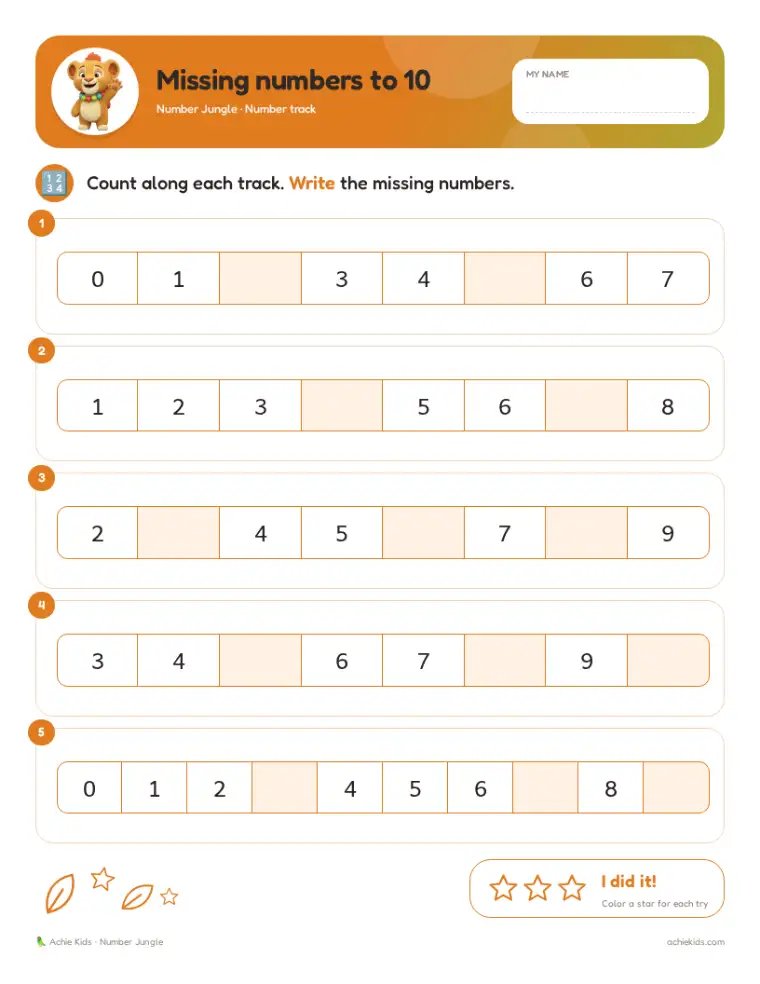
Five number tracks from 0 to 10 with gaps to fill. Count along each track out loud and write the missing numbers — counting on from any number, not just from 1.
Ages 4–5 · 2 pages · color + ink-saver
Math
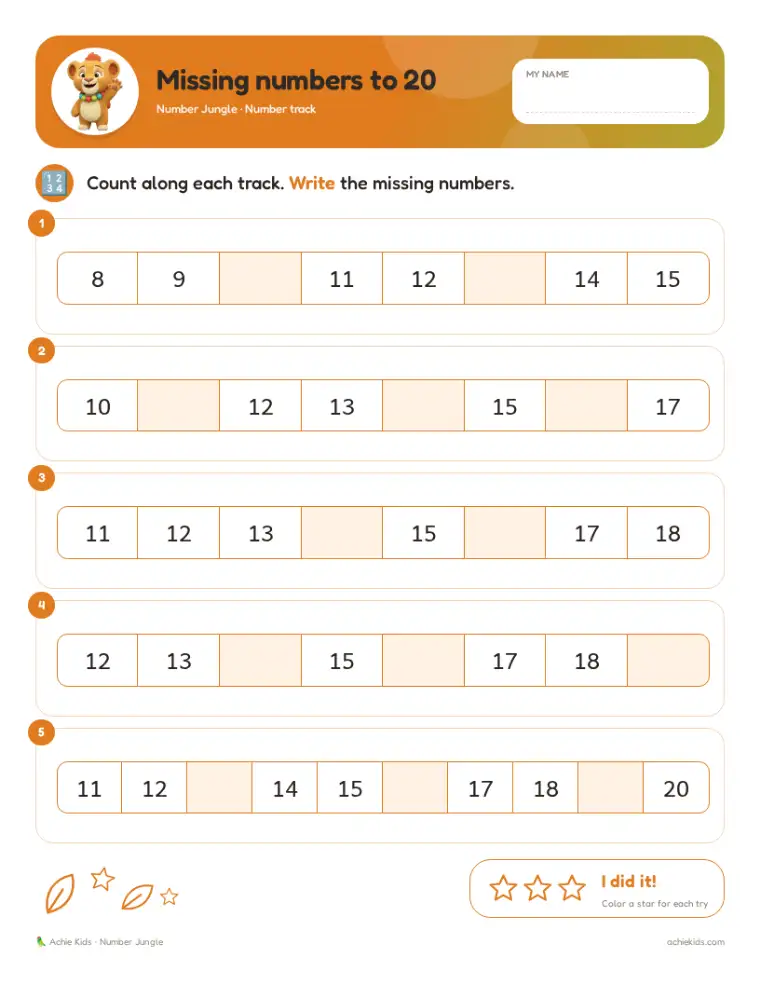
Number tracks through the teens, from 8 to 20, with missing numbers to write. A good check that children can count past 10 and write teen numbers.
Ages 5–6 · 2 pages · color + ink-saver
Math
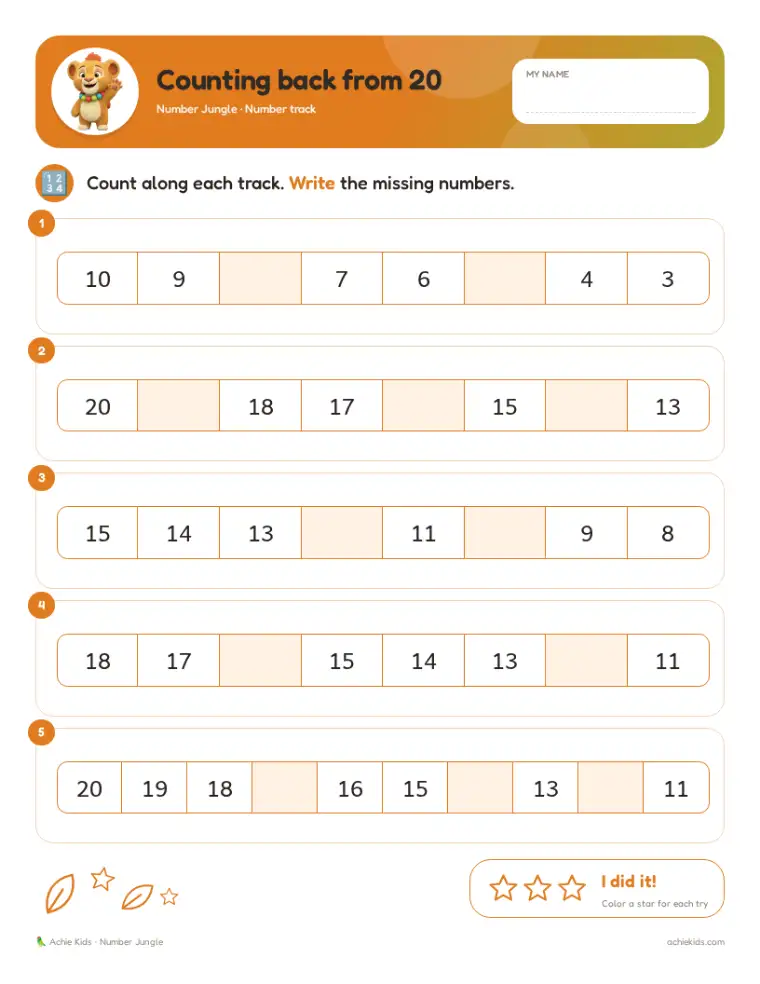
Five number tracks counting backwards, like a rocket countdown: 20, 19, 18… Fill in the missing numbers. Counting back is the start of taking away.
Ages 5–6 · 2 pages · color + ink-saver
Math
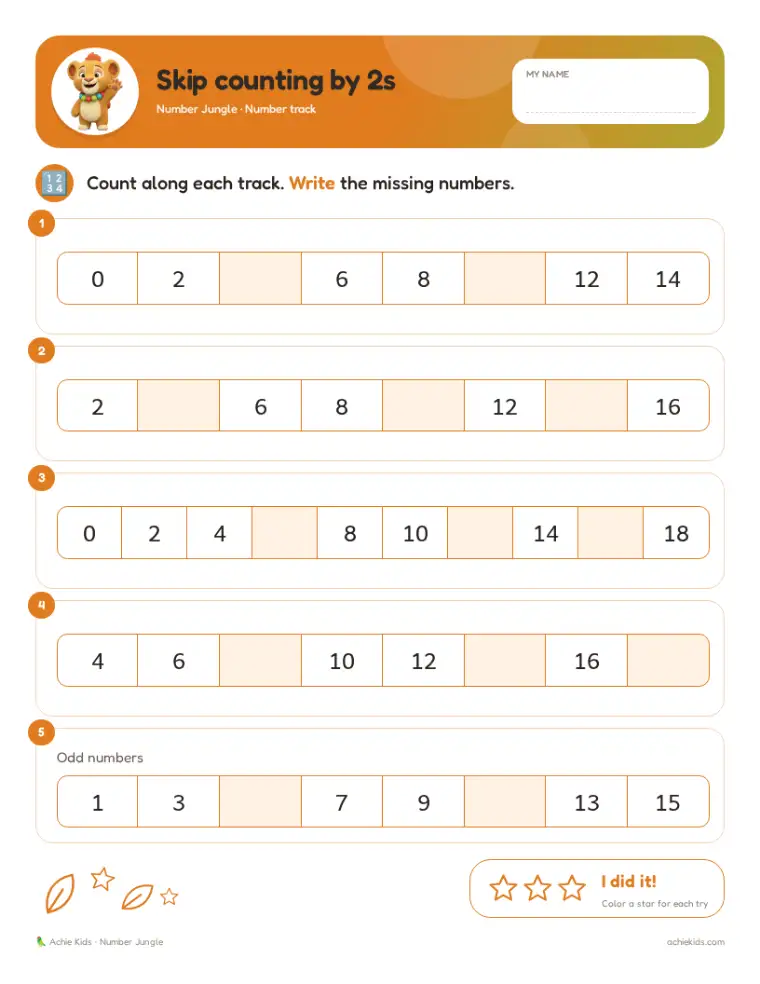
Count in 2s along five number tracks — 0, 2, 4, 6… — and write the missing numbers. The last track counts the odd numbers: 1, 3, 5…
Ages 5–6 · 2 pages · color + ink-saver
Math
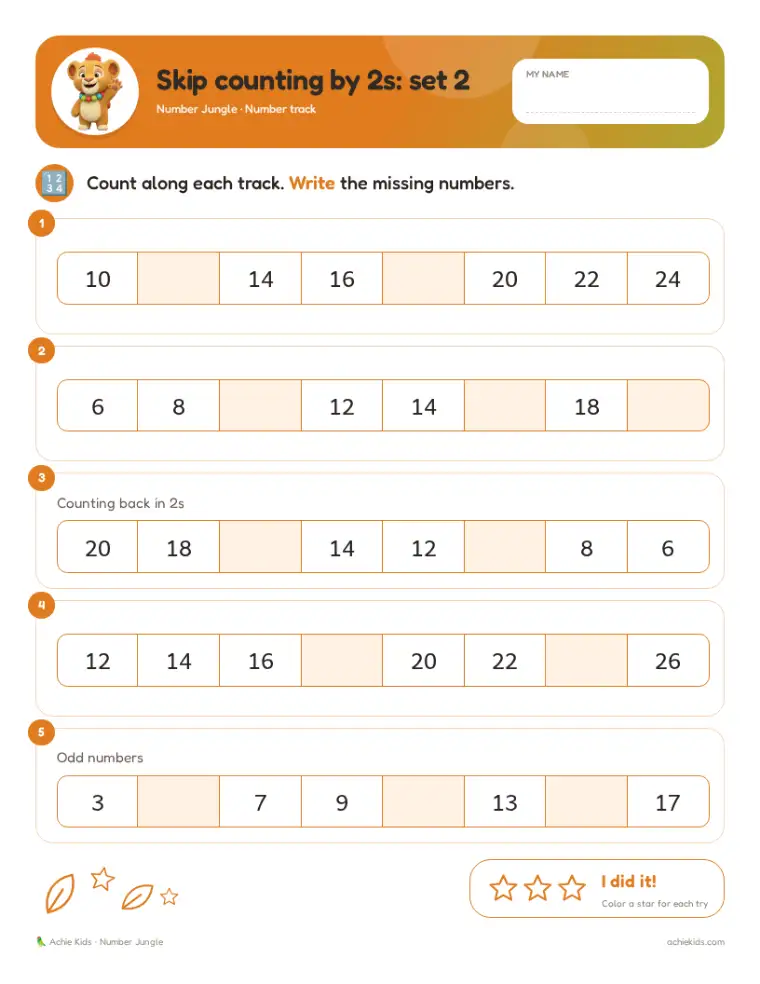
More counting in 2s, now from 10, from 6, odd numbers and backwards from 20 in 2s. Spot the pattern in the last digits: 0, 2, 4, 6, 8.
Ages 6–7 · 2 pages · color + ink-saver

Math
Count in 5s along number tracks to 50 and back. Every number ends in 5 or 0 — a pattern children can hear and see.
Ages 6–7 · 2 pages · color + ink-saver
Math
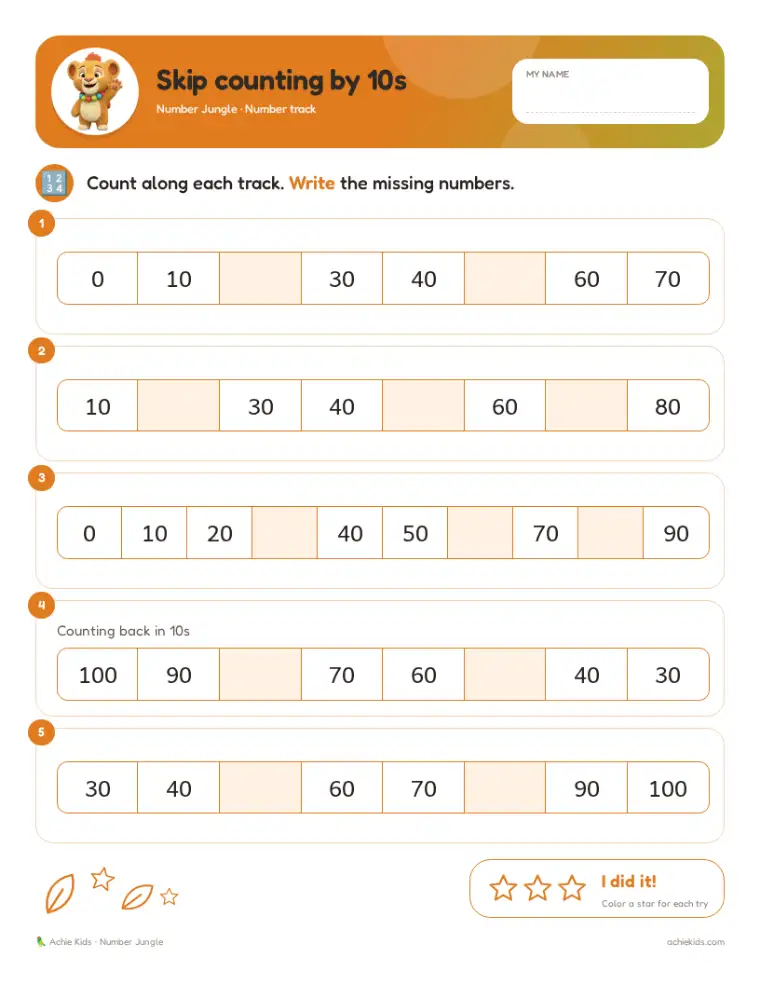
Count in 10s to 100 and back again: 10, 20, 30… Five number tracks with missing tens to write.
Ages 6–7 · 2 pages · color + ink-saver
Math
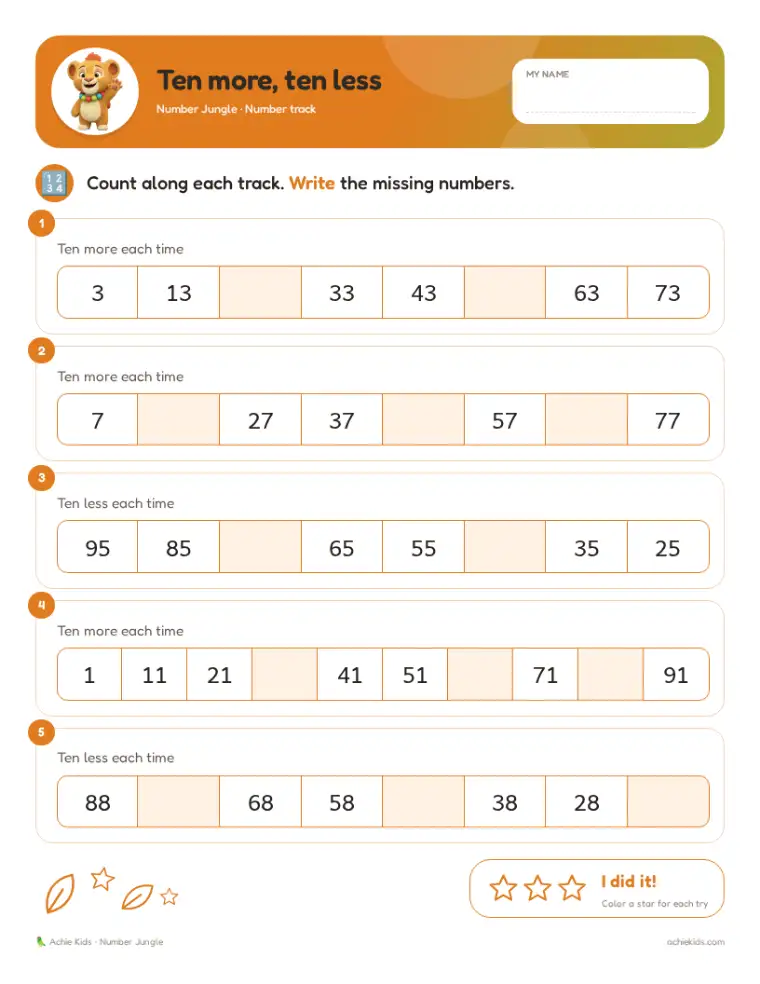
Tracks that jump by ten from numbers like 3, 7 and 95: 3, 13, 23… Only the tens digit changes — a big idea in place value.
Ages 6–7 · 2 pages · color + ink-saver
Math
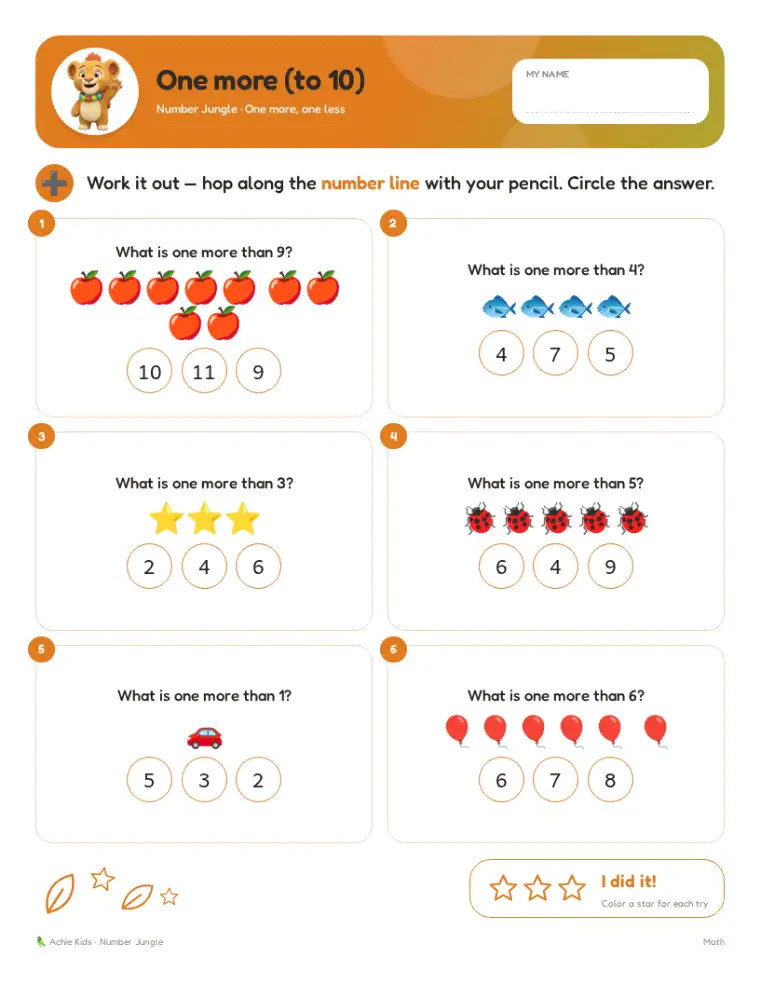
Six questions like “What is one more than 9?” and “What is one more than 4?” with pictures to count. Finding one more and one less is the start of adding and taking away.
Ages 4–5 · 2 pages · color + ink-saver

Math
Six questions like “What is one less than 10?” and “What is one less than 4?” with pictures to count. Finding one more and one less is the start of adding and taking away.
Ages 4–5 · 2 pages · color + ink-saver

Math
Six questions like “What is one more than 19?” and “What is one less than 5?” with numbers to 20. Finding one more and one less is the start of adding and taking away.
Ages 5–6 · 2 pages · color + ink-saver
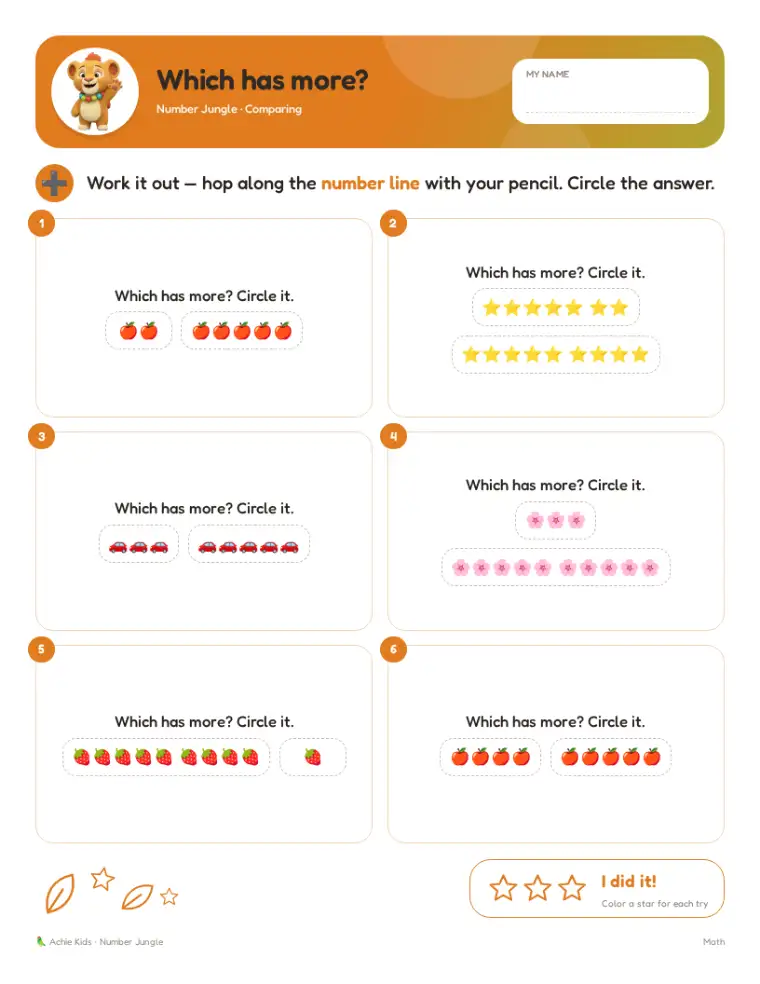
Math
Six pairs of groups to compare: count each group, then circle the one with more. Comparing amounts builds the meaning behind bigger and smaller numbers.
Ages 4–5 · 2 pages · color + ink-saver
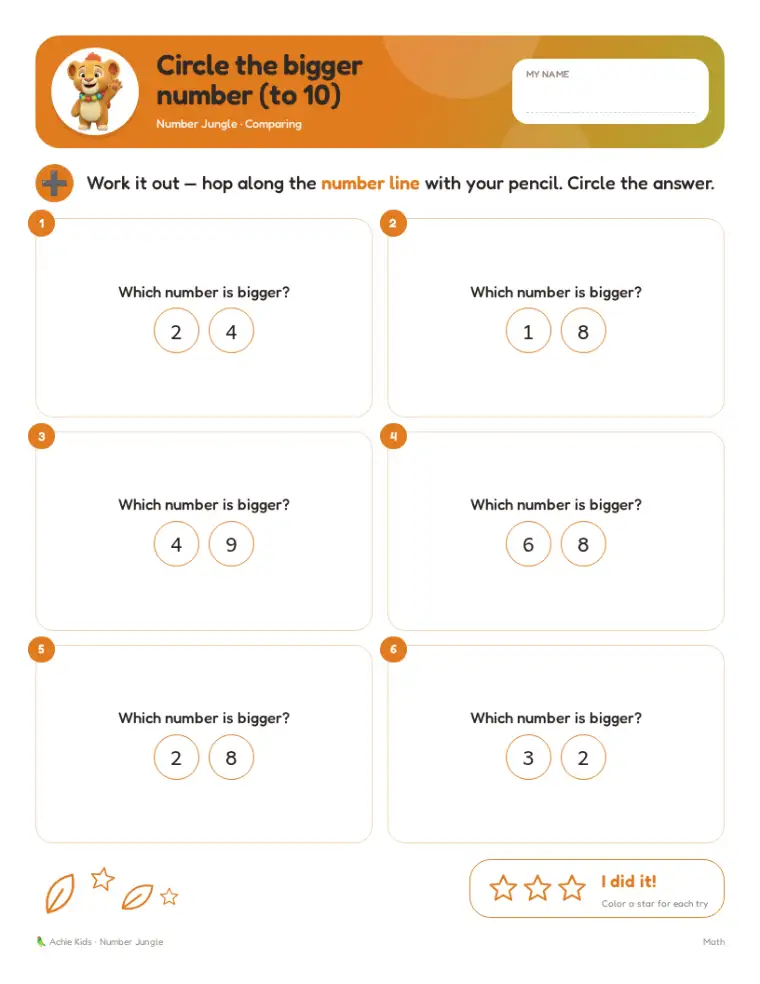
Math
Six pairs of numbers up to 10: circle the bigger number in each pair. Saying “4 is bigger than 2” out loud helps it stick.
Ages 4–5 · 2 pages · color + ink-saver
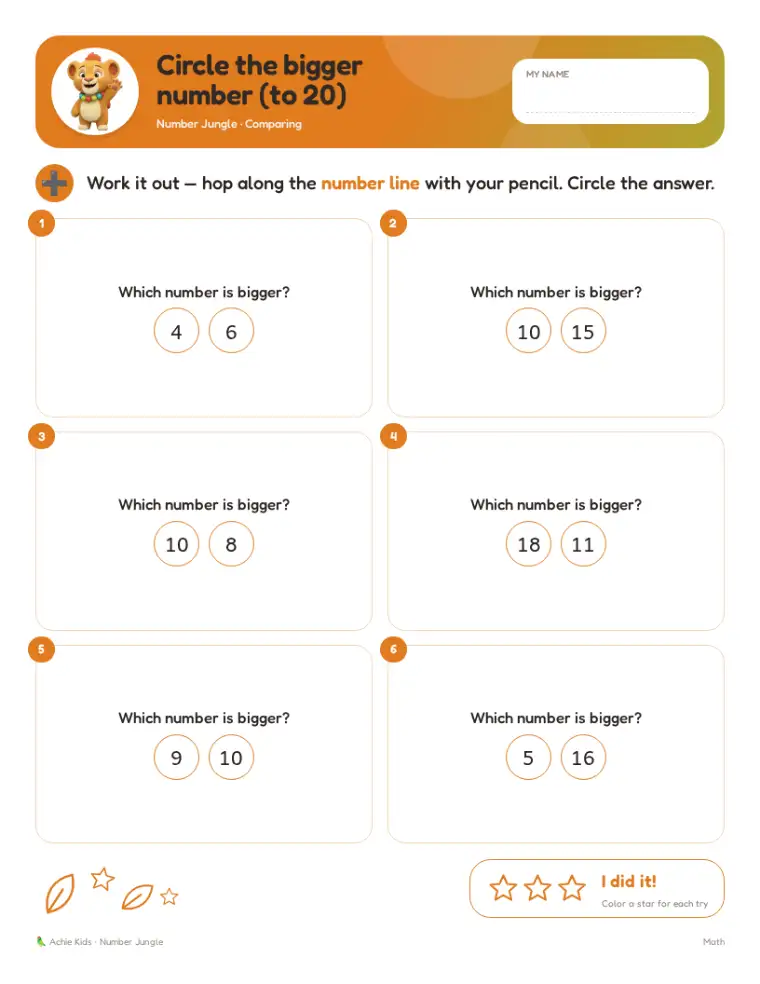
Math
Six pairs of numbers up to 20: circle the bigger number in each pair. Saying “6 is bigger than 4” out loud helps it stick.
Ages 5–6 · 2 pages · color + ink-saver
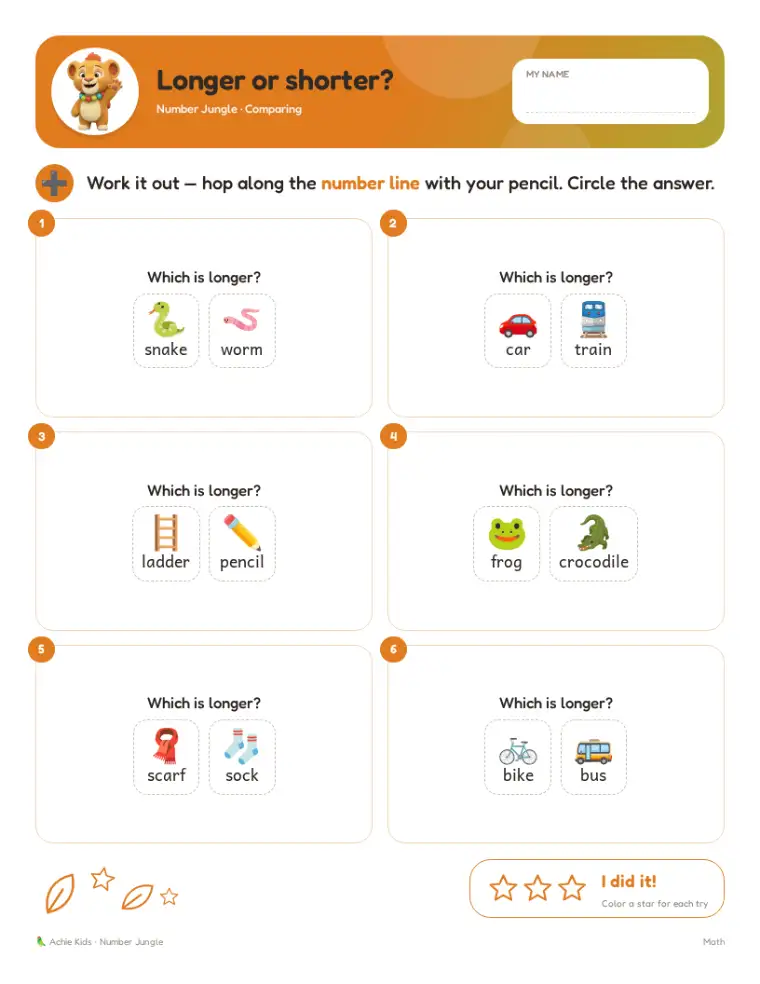 Free
Math
Six pairs to compare — snake or worm, train or car and ladder or pencil… Which is longer? Circle it. Comparing before measuring builds the words children need: longer, taller, heavier, holds more.
Ages 3–5 · 2 pages · color + ink-saver
Math
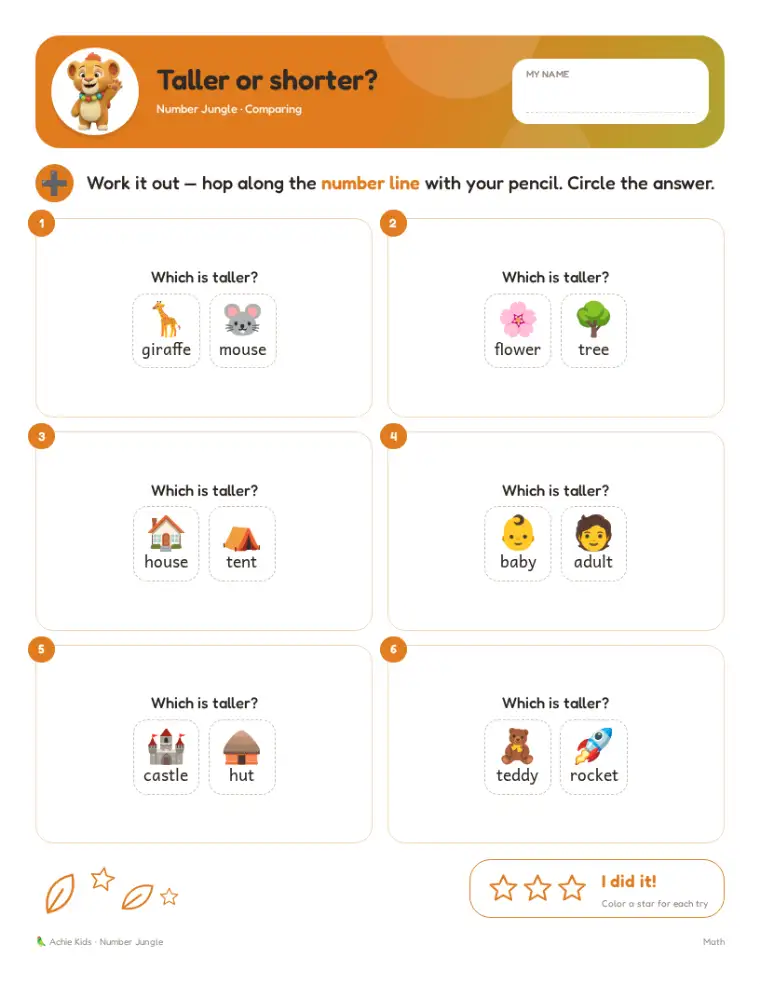
Six pairs to compare — giraffe or mouse, tree or flower and house or tent… Which is taller? Circle it. Comparing before measuring builds the words children need: longer, taller, heavier, holds more.
Ages 3–5 · 2 pages · color + ink-saver
 Free
Math
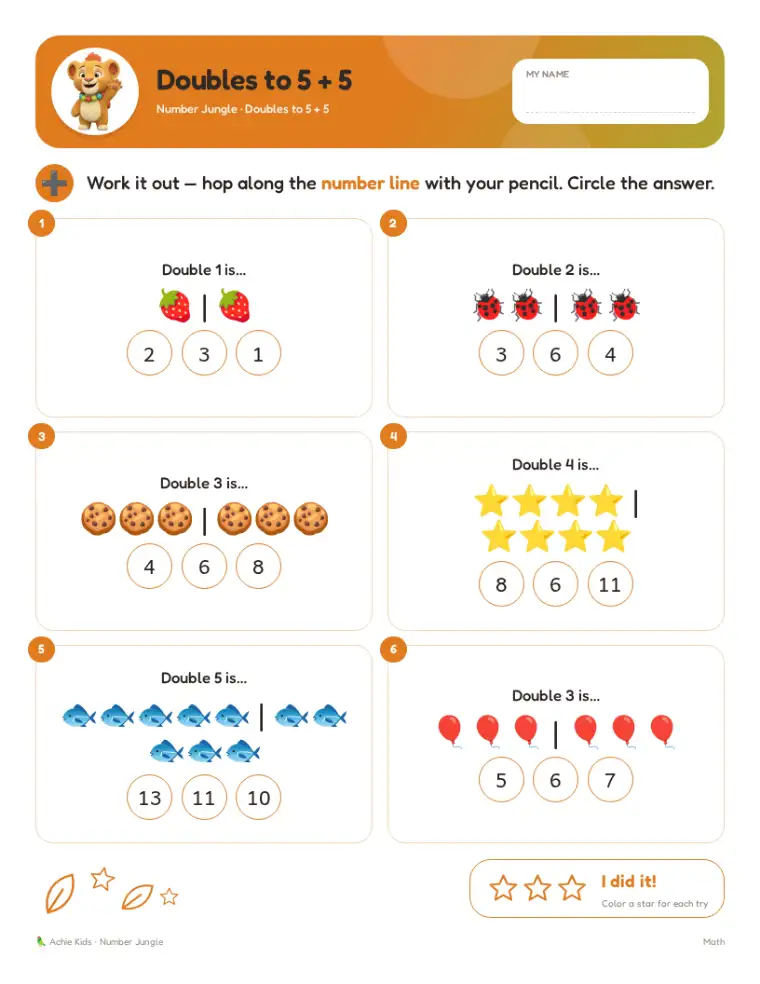
Six doubles — 1 + 1, 2 + 2 and 3 + 3 and more — with two matching groups of pictures to count. Doubles are the first number facts many children know by heart.
Ages 4–5 · 2 pages · color + ink-saver
 Free
Math
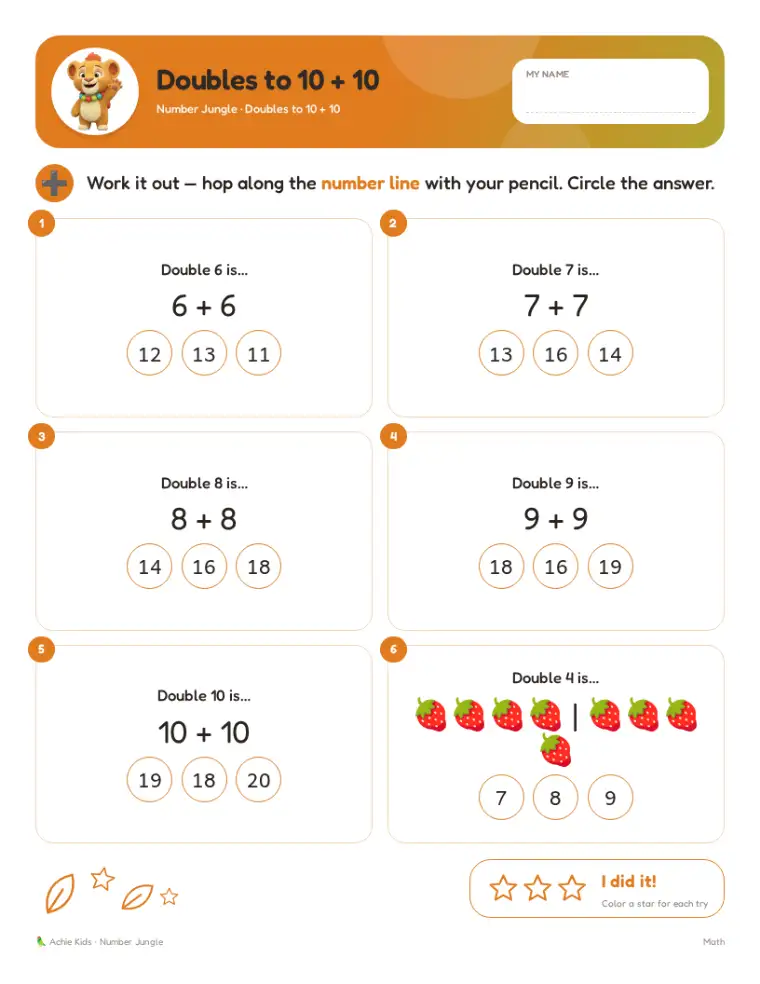
Six doubles — 6 + 6, 7 + 7 and 8 + 8 and more — to work out and remember. Doubles are the first number facts many children know by heart.
Ages 6–7 · 2 pages · color + ink-saver
Math
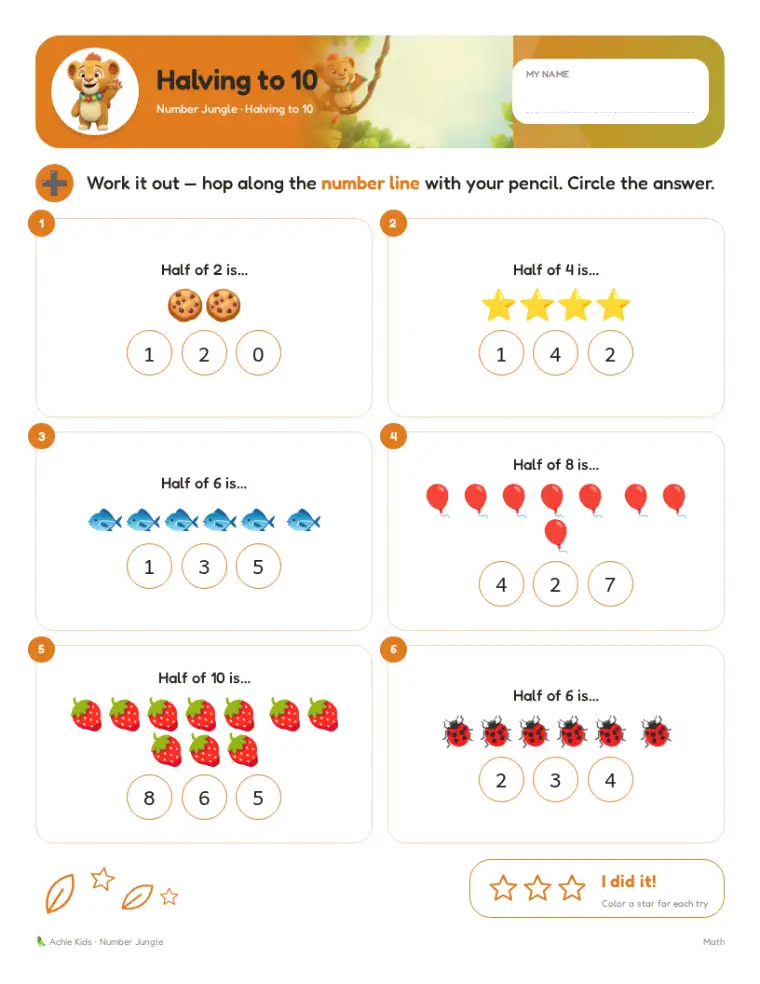
Six halving questions — half of 2, 4 and 6… Share the pictures into two equal groups to find the answer.
Ages 5–6 · 2 pages · color + ink-saver
Math
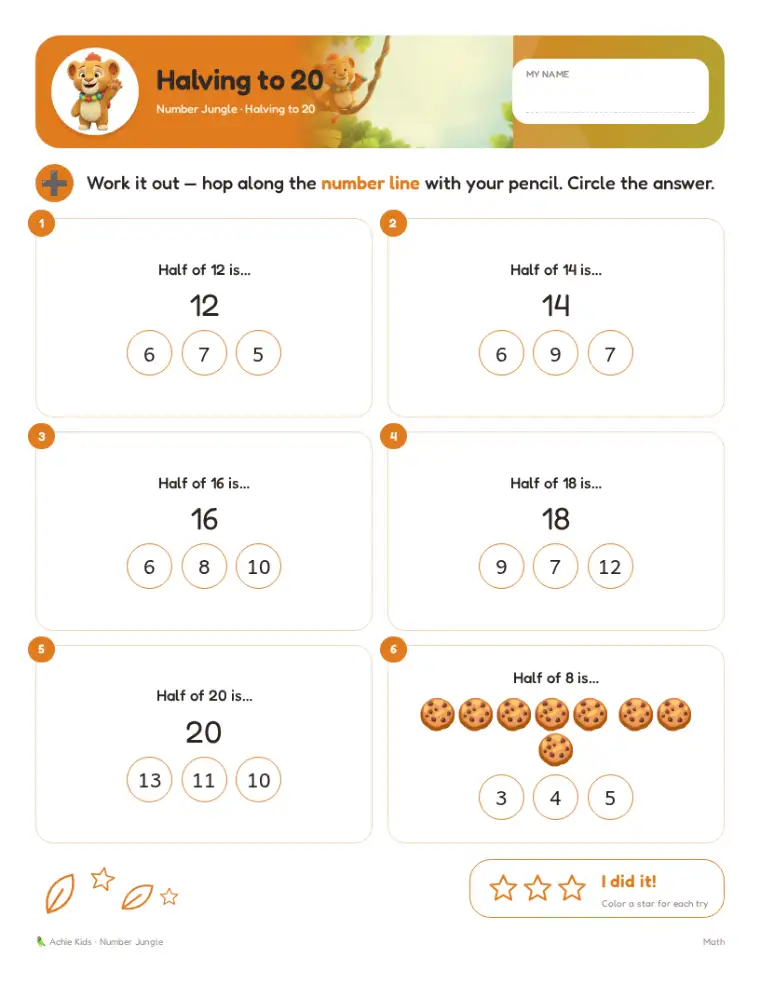
Six halving questions — half of 12, 14 and 16… Use doubles to help: double 7 is 14, so half of 14 is 7.
Ages 6–7 · 2 pages · color + ink-saver
 Free
Math
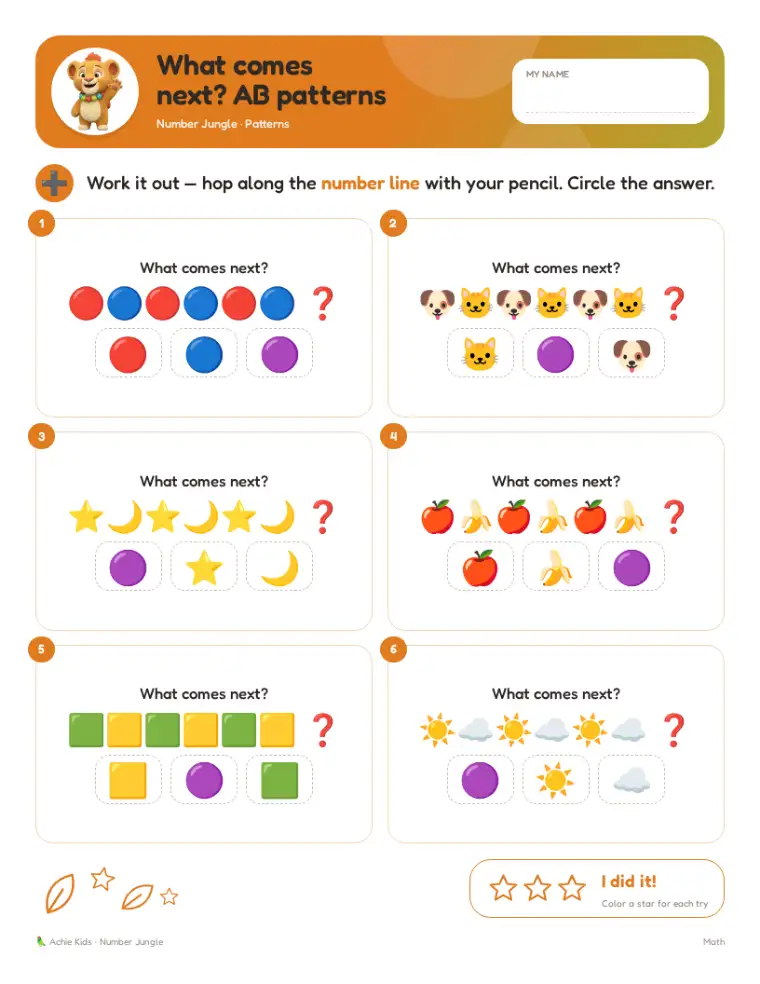
Six simple two-part repeating patterns (AB, like red, blue, red, blue) with colors, animals, fruit and weather. Say each pattern out loud and circle what comes next.
Ages 3–5 · 2 pages · color + ink-saver
Math
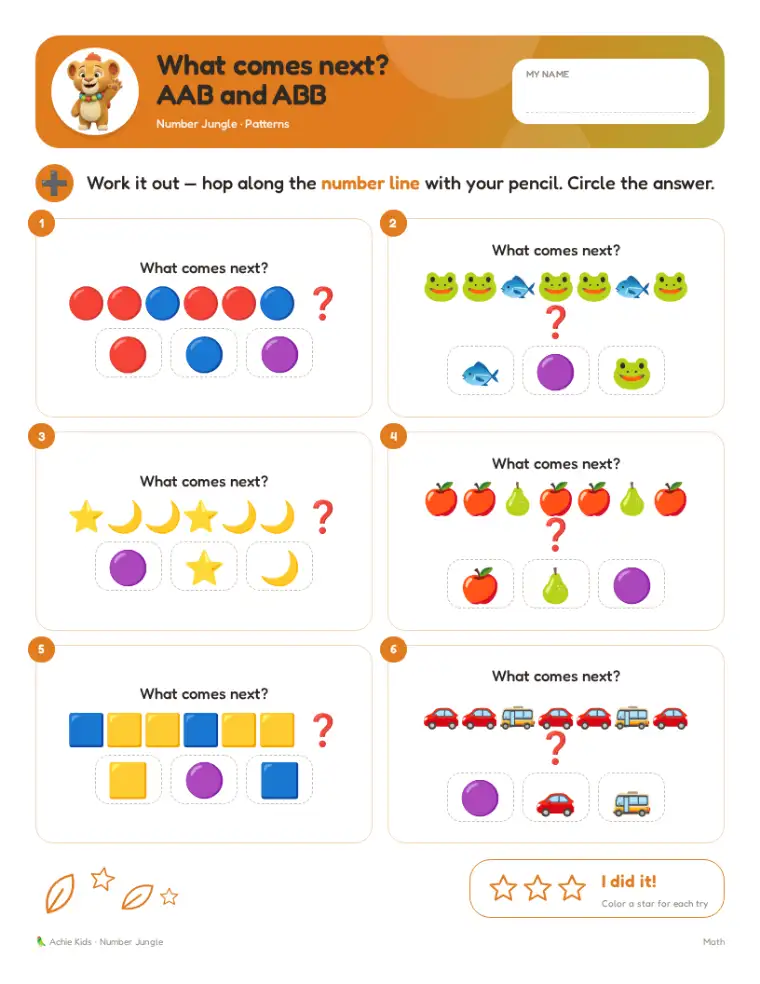
Six trickier repeating patterns (AAB and ABB, like frog, frog, fish) with colors, animals, fruit and weather. Say each pattern out loud and circle what comes next.
Ages 4–5 · 2 pages · color + ink-saver
Math
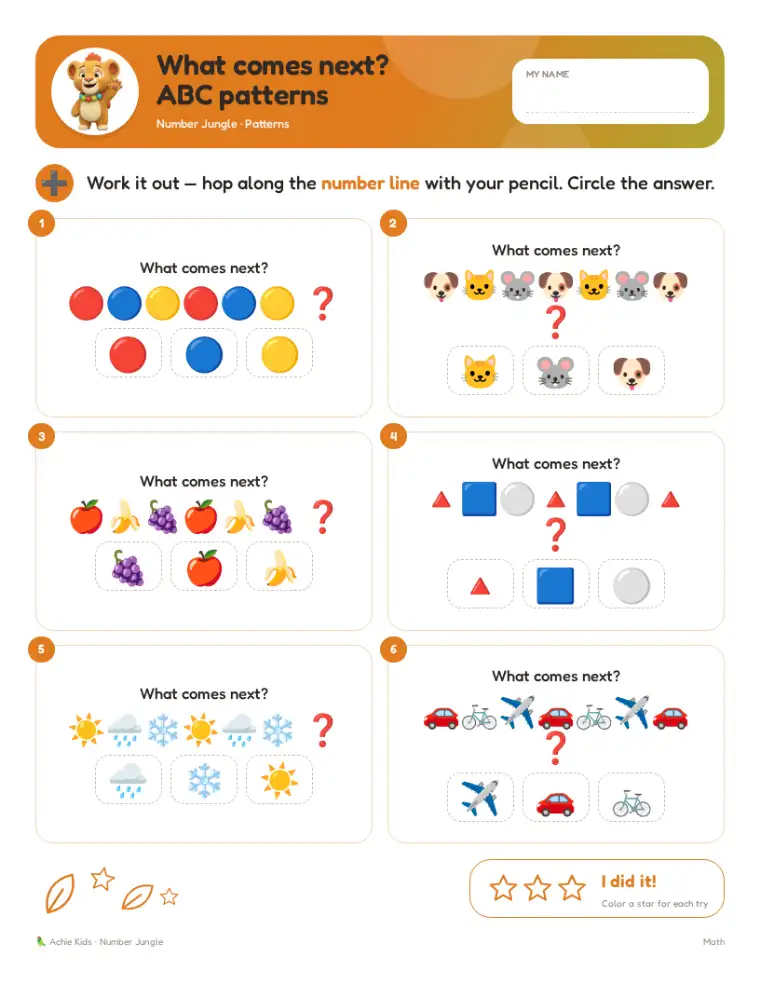
Six three-part repeating patterns (ABC, like dog, cat, mouse) with colors, animals, fruit and weather. Say each pattern out loud and circle what comes next.
Ages 4–5 · 2 pages · color + ink-saver
Math
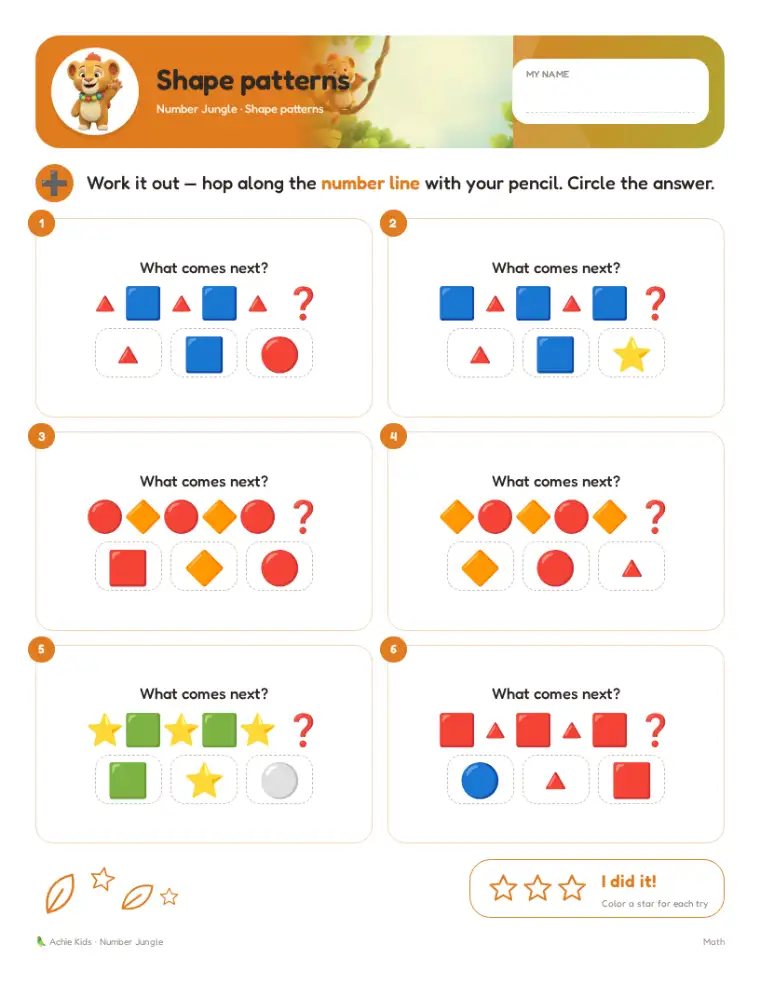
Six repeating patterns made of shapes — triangles, squares, circles, diamonds and stars. Name the shapes out loud, spot the repeating part and circle the shape that comes next.
Ages 4–5 · 2 pages · color + ink-saver
Free sheets print without an account. Family plans unlock the whole bank.